Материал: npe
It is important for photoreception. In case of insufficiency, hemerolapia develops, damage to the mucous membranes and skin.
Vitamin a preparations are indicated:
- in case of violations of twilight vision to increase its acuity (transport workers, pilots);
- in an oil solution, vitamin A is also used for slowly healing wounds, burns, trophic ulcers, etc. in the form of abundantly moistened gauze bandages, for eye diseases - in eye drops.
Side effects:long-term use leads to the development of acute or chronic hypervitaminosis. In acute cases, headache, drowsiness, convulsions, nausea, vomiting, photophobia. In chronic - skin manifestations, hair loss, brittle nails, pain in the bones and joints, dyspeptic symptoms, headache.
Contraindications: hypersensitivity, gallstone disease, chronic pancreatitis, pregnancy in the 1st trimester.
Tocopherol (vitamin E) - regulates oxidative processes, inhibits the oxidation of unsaturated fatty acids, prevents the formation of their peroxides.
Indications:treatment and prevention of hypovitaminosis; with spontaneous abortion; muscular dystrophy; angina pectoris; damage to peripheral vessels; rheumatoid arthritis; climacteric autonomic disorders; neurasthenia with overwork.
Side effects: Allergic reactions: itching, flushing of the skin; from the digestive system: diarrhea, nausea, gastralgia, dyspepsia.
Contraindications:hypersensitivity; severe atherosclerosis of the coronary arteries, myocardial infarction, increased risk of thromboembolism.
Ergocalciferol and cholecalciferol (vitamin D2 and D3) -contained in the fat of the liver of tuna, cod, halibut. Mechanism: increases the permeability of the intestinal epithelium for calcium and phosphates. It is absorbed in the small intestine, with lymph it enters the liver and the general bloodstream, in plasma it binds to alpha globulin, which transports to various organs.
Failure leads to the development of rickets, osteomalacia, osteoporosis.
Indications: - prevention and treatment of rickets and rickets-like diseases in children;
- in complex therapy used in osteopathies of various origins, in patients with orthopedic pathology (osteoporosis) or delayed consolidation of fractures.
Contraindications:hypercalcemia; hypervitaminosis D; renal osteodystrophy with hyperphosphatemia; pregnancy, lactation, hypersensitivity to the components of the drug.
Side effects: constipation or diarrhea, dryness of the oral mucosa, headache, thirst, nocturia, polyuria, metallic taste in the mouth, nausea, vomiting, asthenia, bone pain, cloudy urine, arrhythmia, drowsiness, myalgia.
Phylloquinone (vitamin K) - stimulates the synthesis of prothrombin, proconvertin in the liver.
Indications: as hemostatics for bleeding; hemorrhagic diathesis; with hemorrhagic disease of newborns; hepatitis; cirrhosis of the liver; chronic diarrhea; stomach ulcer; with uterine bleeding.
Contraindications:individual intolerance; pregnancy; lactation period.
Side effects:large doses lead to hemolytic anemia; allergic reactions; thromboembolism; increased blood clotting; hyperbilirubinemia.
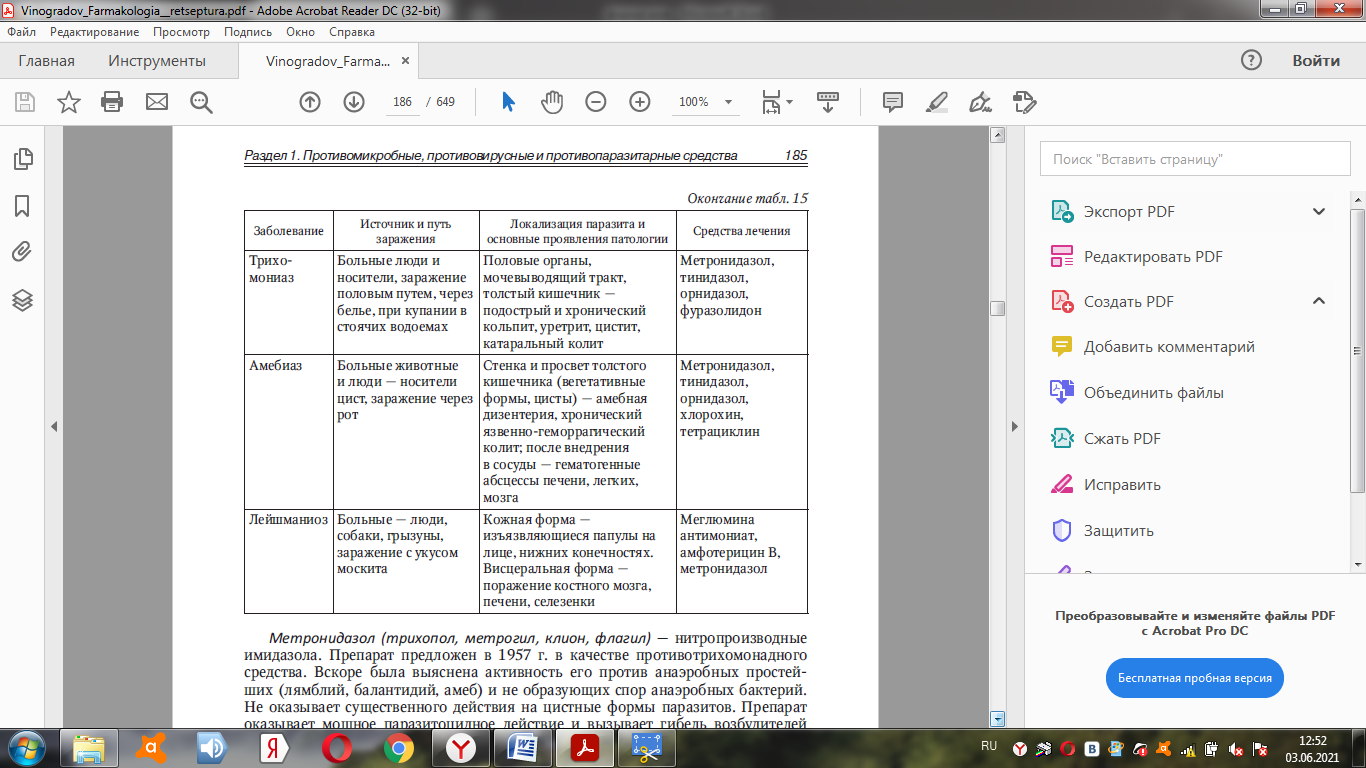
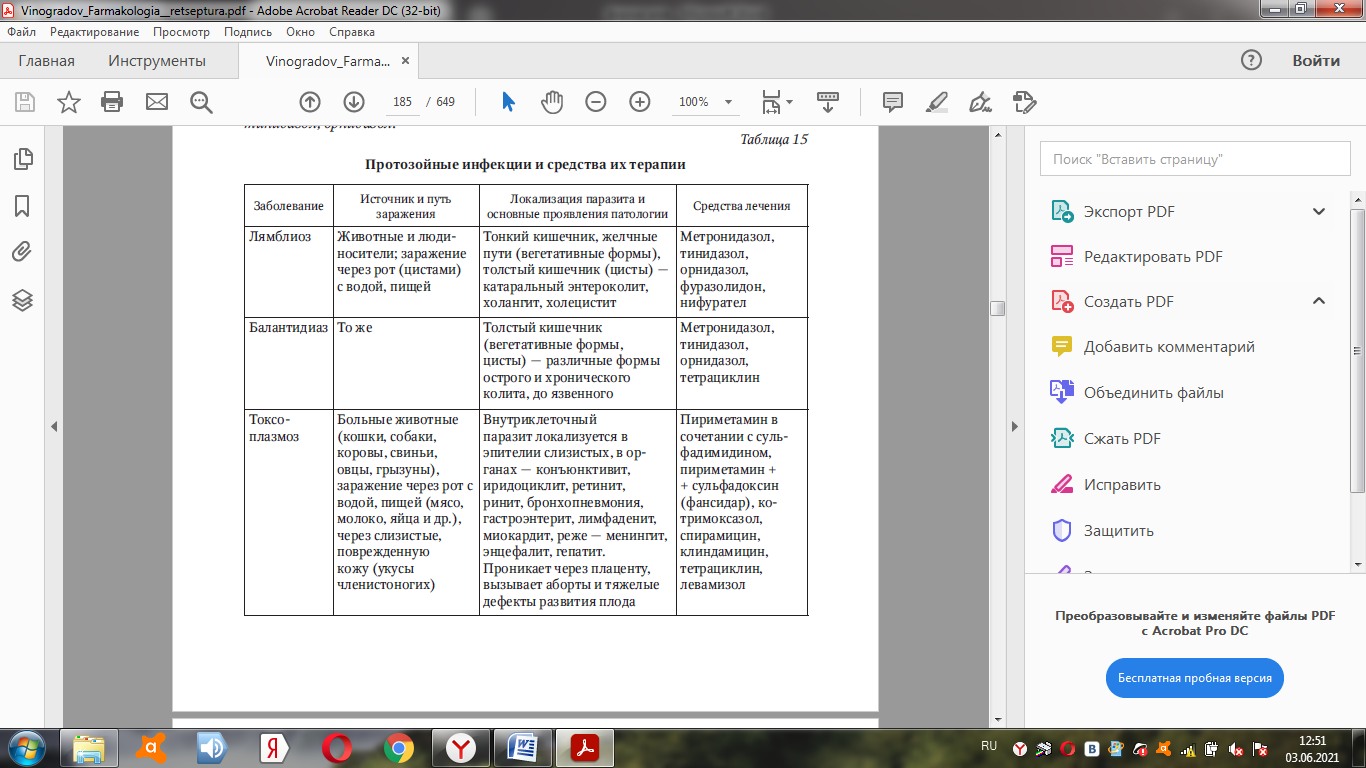
4. Means used in the treatment of protozoal infections (amebiosis, leishmaniasis, giardiasis, trichomonadosis, balantidiasis). Classification. Mechanism of action. Indications for use. Side effects. Contraindications Comparative evaluation of drugs.
Amoebiasis: at any localization (metronidazole); in the intestinal lumen (quiniofon); in the lumen and wall of the intestine (tetracycline); in the wall of the intestine and liver (emetine); in the liver (hingamin).
Mechanism:amoebicidal, tetracycline inhibits intestinal flora and this inhibits the growth and reproduction of amoebas (indirect division). A side effect is diarrhea, emetine accumulates (damage to the CVS, gastrointestinal tract, nervous system, kidneys and liver). It is impossible for diseases of the heart and kidneys. Combinations of drugs are used: metronidazole + quiniofon.
Leishmaniasis: for visceral and skin (solusurmin), for skin (monomycin, metronidazole), topically (akrikhin).
Mechanism:bactericidal. Side effects - nausea, headache, rash, inhibition of hematopoiesis, ↓ blood pressure. In case of an overdose of solusurmin - unitiol. Contraindications: acute infectious diseases, intoxication, organ damage to internal organs. Monomycin oto- and nephrotoxicity. Akrikhin is not allowed for mental illness.
Giardiasis:metronidazole, aminoquinol, furazolidone. Mechanism: ↓ activity of enzyme systems, disruption of protein and nucleic acid synthesis. Side effects - dyspepsia, headache, allergies, inhibition of hematopoiesis. Contraindications: violation of hematopoiesis, diseases of the central nervous system.
Trichomoniasis: metronidazole, tinidazole, trichomonacid, nitazole. Mechanism: bactericidal action. Side effects - dyspepsia, tremors. Contraindications: pregnancy in the 1st trimester, lactation, hematopoiesis disorder, central nervous system diseases. Tinidazole is more active than metronidazole.
Toxoplasmosis:chloridine, sulfonamides, pentamidine. Mechanism: bacteriostatic (chloridine inhibits the transition of dihydrofolic acid to tetrahydrofolic acid). Side effects - teratogenic effects, anemia, leukopenia. Contraindications: pregnancy, blood and kidney diseases.
Balantidiasis: monomycin, tetracycline, quiniophone.
Ticket 15
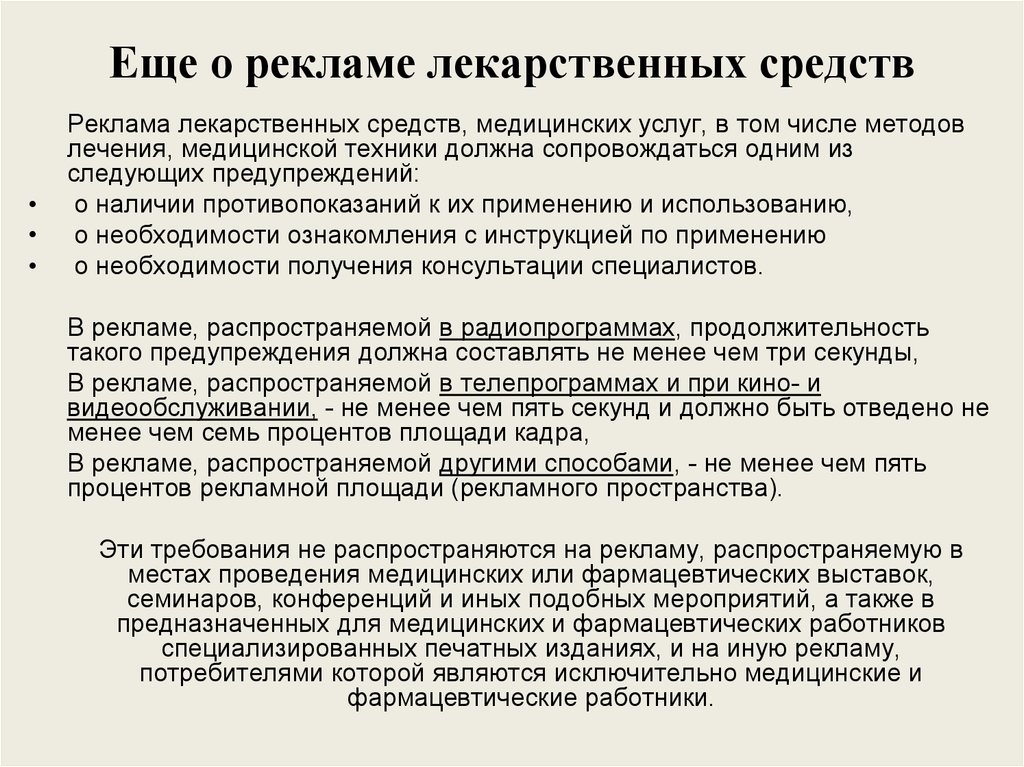
1. Conditions affecting the manifestation of the action of medicinal substances in the body. The importance of the psychogenic factor in the effectiveness of drug treatment; the word of the doctor and the prescription of drugs. The ethical side of the advertising of new drugs.
2. Nootropics. Classification. Mechanism of action. Indications for use. Side effects. Contraindications Comparative evaluation of drugs.
3. Antihypertensive drugs of peripheral neurotropic action. Classification. Mechanism of action. Side effects. Contraindications Comparative evaluation of drugs.
4. Anti-tuberculosis drugs. Classification. Mechanism of action. Indications for use. Side effects. Contraindications Comparative evaluation of drugs.
1. Conditions affecting the manifestation of the action of medicinal substances in the body. The importance of the psychogenic factor in the effectiveness of drug treatment; the word of the doctor and the prescription of drugs. The ethical side of the advertising of new drugs.
Age - there is perinatal pharmacology (from 24 weeks of the fetus to 4 weeks of newborn), newborns differ from adults (deficiency of enzymes, kidney function, ↑ BBB permeability, underdevelopment of the central nervous system). There is pediatric pharmacology - doses per kg of body weight. There is geriatric pharmacology - in people of age, the doses should be ↓ (since ↓ absorption, metabolism, excretion by the kidneys).
Gender - men are less sensitive to a number of substances than women (strychnine, nicotine).
Genetic factors - enzyme deficiency, atypical reactions (idiosyncrasy). Studying pharmacogenetics.
The state of the body - pharmacokinetics changes with illness, pregnancy, obesity.
Circadian rhythms (circadian) - studies chronopharmacology. The effect of substances changes qualitatively and quantitatively (pronounced effect during the period of maximum activity). Absorption, metabolism change during the day.
Psychogenic factor - if the patient is committed to treatment, trusts the doctor, follows the recommendations, the treatment will be effective. Otherwise, the effect of the treatment cannot be expected.
The word of the doctor is the therapeutic effect of the word of the doctor on the patient.
Ethics:
2. Nootropics. Classification. Mechanism of action. Indications for use. Side effects. Contraindications Comparative evaluation of drugs.
Nootropic drugs (Greek noos - soul. Thought, tropos - direction) - a group of drugs that have a selective mnemotropic effect, improve the higher integrative functions of the brain - intelligence, attention, short- and long-term memory, creating the ability to quickly reproduce information, accelerating learning, as well as weakening the perception of stressful situations and increasing the brain's resistance to harmful influences.
Classification
1. Means affecting specific neurotransmitter systems
∙ Catecholaminergic drugs PIRIBEDIL
(pronoran,)
GUANFACIN
(estulik)
∙ GABAergic agents: ∙ GABA AMINALON
(gammalon, ganervin)
∙ GABA + nicotine acid PICAMILON
∙ phenyl derivative of GABA PENIBUT
2. Drugs with neurometabolic action
∙ Animal origin ACTOVEGIN
∙ Plant origin EXTRACT
LEAVES
GINKGO BILOBA
(tanakan, ginos,
bilobil, memoplant)
∙ Synthetic: ∙ amino acids GLYCINE (glycol)
∙ analogue of coenzyme Q10 IDEBETON (noben)
∙ pyrrolidone derivatives PIRACETS
(nootropil)
(cyclic derivatives of GABA) EPIRACETS
AMERACETS
OXYRATE
POLSIRACETAM
∙ pyridoxine derivatives PYRIDITOL (enerbol,
pyritinol, ecephabol)
GLUTAMINE ∙ ∙ dimethylamineethanol derivatives DEMANOL
ECLIDAN
ACEFEN
∙ HOPANTHENIC ACID (pantogam)
3. Drugs with neurotrophic action
CORTEKSIN
Cerebrolysin
4. Funds with vasoactive action
∙ Ca² antagonists + CINNARIZINE (stugerone, vertizin)
∙ Derivatives of alkaloids DIHYDROERGOCRYPTIN
ergot NITSERGOLIN (sermion)
∙ Derivatives of alkaloids CAVINTON (vinpocetine)
periwinkle VINKAMIN (oxybral)
VINCANOR
5. Combined funds
FESAM (PIRACETS + CINNARIZINE)
Mechanisms of action
1. Improving the bioenergetics of the brain.
Nootropic drugs increase the synthesis of ATP and cAMP, glucose utilization, increase glycolysis and aerobic respiration, and promote an increase in the activity of adenylate cyclase (for aging and neuropsychiatric diseases, energy deficiency and a decrease in the activity of adenylate cyclase in neurons are characteristic).
2. Increased synthesis and release of neurotransmitters.
Nootropic drugs activate the synthesis, release and turnover of dopamine, norepinephrine, acetylcholine, inhibit MAO, increase the formation of β - adrenergic receptors, cholinergic receptors and neuronal uptake of choline. In the mechanism of neurotransmitter release, the blockade of potassium channels is important, which facilitates membrane depolarization.
3. Increase in protein synthesis and membrane phospholipids.
Nootropic drugs improve the regeneration of neurons, activate their genome and increase the synthesis of informational neuropeptides, enhance the metabolism of phosphatidylcholine and phosphatidylethanolamine.
4. Improvement of cerebral blood flow and hemorheological parameters.
Nootropic drugs dilate cerebral vessels, improve blood flow in areas of cerebral ischemia, prevent the development of cerebral edema, block platelet aggregation, thrombus formation, improve the elasticity of erythrocytes and microcirculation. Nicotinic acid in PICAMILON has a direct vasodilating and anti-sclerotic effect.
5. Antioxidant action.
Nootropic drugs, inhibiting free radical peroxidation, protect against destruction of phospholipids of neuronal membranes, which facilitates the fixation of memory traces. Lipid peroxidation increases in the brain during organic diseases, aging and stress.
6. Potentiation of non-tropic effects of memory neuropeptides
PIRACETAM, whose pyrrolidone ring does not open to form a linear GABA molecule, is an agonist of receptors that receive signals from memory neuropeptides (fragments of ACTH, vasopressin, substance P). In terms of chemical structure, PIRACETS is similar to the cyclic form of the terminal amino acid of memory neuropeptides - pyroglutamate and affects receptors as an exogenous ligand. Probably, the most important for the mnemotropic action of PIRACETAM is the activation of AMPA - glutamic acid receptors.