Материал: Матвиенко РГР Квант. эл. 12 вариант
Міністерство освіти і науки України
Сумський державний університет
КАФЕДРА НАНОЕЛЕКТРОНІКИ
Розрахунково-графічна робота
з предмету: «Квантова та оптоелектроніка»
з теми: «Розрахунок енергетичних характеристик твердотільного лазера, що працює в режимі модульованої добротності»
Варіант № 12
Виконав
студент групи ФЕ-31 Матвієнко Б.І.
Перевірив Кривець О.С.
Суми 2016
Зміст
1. Завдання…………………………………………………………………………3
2. Вступ………………………………………………………………………….....4
3. Розділ 1. Аналіз трирівневої схеми другого типу…….……………………..7
4. Завдання 1. Трирівнева схема другого типу……………………………..…..7
5. Розділ 2. Теоретичні відомості про лазери…………………………….……11
6. Завдання 2. Metal Vapor Lasers…………...……………………………….….11
7. Завдання 3.Принцип роботи лазера на рубіні. Схема енергетичних рівнів рубінового лазера ............................................................................................….21
8. Завдання 4. Робота лазера в режимі модульованої добротності…….......…27
9. Висновок………………………………………………………………..…….34
10. Література……………………………………………………………………35
Завдання розрахунково-графічної роботи
1. Проаналізувати механізм створення інверсної заселеності в трирівневій схемі другого типу. Визначити залежність заселеності рівнів від щільності (інтенсивності), що збуджує випромінювання накачування.
2. Знайти та зробити переклад англійської статті, ессе, лекції з підручника про лазери.
3. Замалювати схему енергетичних рівнів рубінового лазера. Описати принцип роботи лазера на рубіні.
4. Описати роботу лазера в режимі модульованої добротності.
Вступ
В даний час області застосування лазерів розширюються з кожним днем. Після першого промислового використання лазерів для отримання отворів в рубінах для годинників, ці пристрої успішно застосовуються в самих різних областях.
Лазерні
системи діляться на три основні групи:
твердотільні лазери, газові, серед яких
особливе місце займає
 -
лазер, і напівпровідникові лазери.
-
лазер, і напівпровідникові лазери.
Лазери на рубіні. У лазерах цей кристал має високий поріг генерації і отже низький ККД, зазвичай 0.5%. Його вихідна потужність також сильно залежить від робочої температури, що обмежує частоту повторення імпульсів величиною 10 Гц або менше. У той же час цей матеріал термічно стійкий і не боїться перегріву. Однак його широке застосування обмежує досить висока вартість спеціально вирощеного кристала, особливо якщо потрібно стрижень великих розмірів. Тому рубінові лазери застосовуються, коли необхідне випромінювання довжиною хвилі 694 нм, або не потрібна висока енергія на виході і ККД не відіграє суттєвої ролі. Наприклад, такі лазери стали широко використовуватися для спеціальної фотографії - голографії, після того, як вдалося домогтися достатньої чутливості плівки на частоті 694 нм. Ці лазери більш зручні і для пробивання дуже точних отворів, оскільки із зменшенням довжини хвилі розміри точки фокусу, що обмежується дифракцією, зменшуються.
Твердотільні лазери. Це лазери на люмінісцируючих середовищах. Це лазери на склі, що активуються неодимом , лазери на кристалі ітрій-літієвого флюориту, легованого ербієм або їх аналоги. Це лазери з оптичним накачуванням. ККД таких лазерів не вище 5%, проте потужність практично не залежить від робочої температури. Так як це порівняно дешевий матеріал, підвищення потужності можна проводити простим збільшенням розміру робочого елементу. Ці типи лазерів застосовуються в лазерній спектроскопії, нелінійній оптиці, лазерній технології: зварювання, гарт, зміцнення поверхні. Лазерне скло застосовується в потужних установках для лазерного термоядерного синтезу.
Газові
лазери. У газових лазерах існує кілька
сумішей газів, які можуть випускати
вимушене випромінювання. Один з газів
- двоокис вуглецю, що застосовується в
 і СО - лазерах потужністю більше 15 кВт
з поперечним накачуванням електричним
розрядом. А також газодинамічні лазери
з тепловим накачуванням, у яких основна
робоча суміш:
і СО - лазерах потужністю більше 15 кВт
з поперечним накачуванням електричним
розрядом. А також газодинамічні лазери
з тепловим накачуванням, у яких основна
робоча суміш:
 або
або
 .
.
Відома термічна обробка матеріалів і деталей звичайними засобами. Попередній підігрів з використанням газових лазерів дозволяє обробляти матеріали вищої твердості. Прямолінійні ділянки багатокомпонентних деталей легко зварюються газовими лазерами, в той час як непрямолінійність ділянки зварюється з використанням спеціальних поворотних дзеркальних систем. Проводиться лазерний гарт і заточка деталей. Застосовуються подібні лазери в спектроскопії, лазерній хімії, медицині.
Інші газові лазери. Електророзрядні лазери низького тиску на благородних газах: He-Ne, He-Xe і ін. Ці малопотужні системи відрізняються високою монохроматичністю і спрямованістю. Застосовуються в спектроскопії, стандартизації частоти і довжини випромінювання, в настройці оптичних систем.
Іонний аргоновий лазер - лазер безперервної дії, що генерує зелений промінь. Накачування здійснюється електричним розрядом. Потужність досягає декількох десятків Вт. Застосовується в медицині, спектроскопії, нелінійній оптиці.
Хімічні лазери. Робоче середовище - суміш газів. Основне джерело енергії - хімічна реакція між компонентами робочої суміші. Можливі варіанти лазерів імпульсної і безперервної дії. Вони мають широкий спектр генерації в ближній ІЧ - області спектра. Мають велику потужність безперервного випромінювання та велику енергію в імпульсі. Такі лазери застосовуються в спектроскопії, лазерній хімії, системах контролю складу атмосфери.
Напівпровідникові лазери складають найчисленнішу групу. Накачування здійснюється інжекцією через гетероперехід, а також електронним пучком. Гетеролазери мініатюрні, мають високий ККД. Можуть працювати як в імпульсному, так і в безперервному режимах. Незважаючи на низьку потужність вони знайшли своє застосування в промисловості. Вони застосовуються для спектроскопії, оптичної стандартизації частоти, оптико-волоконних ліній зв'язку, для контролю форми, інтерференційних смуг деформації, в оптико-електроніці, у робототехніці, в системах пожежної безпеки. У побуті застосовуються в системах оптичної обробки інформації (в сканерах) в парі з нескладною системою багатогранних дзеркал, застосовуваних для відхилення променя, в звуко- і відеосистемах, в охоронних системах. Останнім часом напівпровідникові лазери, завдяки своїм малим розмірам, застосовуються і в медицині. Лазери з електронним накачуванням перспективні в системах проекційного лазерного телебачення.
З кожним роком лазери все міцніше входять в промисловість і побут людини.
Розділ 1. Аналіз трирівневої схеми другого типу
Завдання 1
Проаналізувати механізм створення інверсної заселеності в трирівневій схемі другого типу. Визначити залежність заселеності рівнів від щільності (інтенсивності), що збуджує випромінювання накачування.
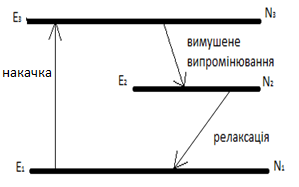
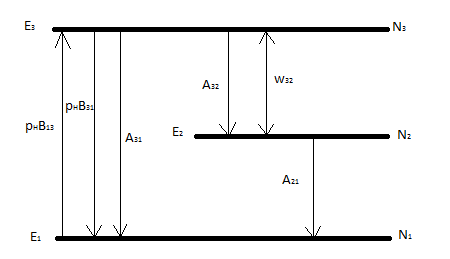
Рисунок 1. Трирівнева схема другого типу
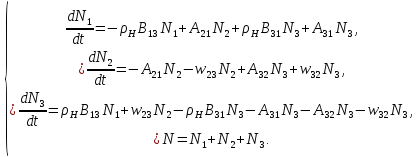

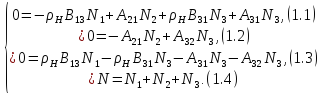
З
рівняння (1.4) виразимо
 :
:

Підставимо рівняння (1.5) до рівняння (1.1) та отримаємо:




Підставимо рівняння (1.6) до рівняння (1.2):




Підставимо рівняння (1.7) до рівняння (1.3):








Підставимо рівняння (1.7) до рівняння (1.2):






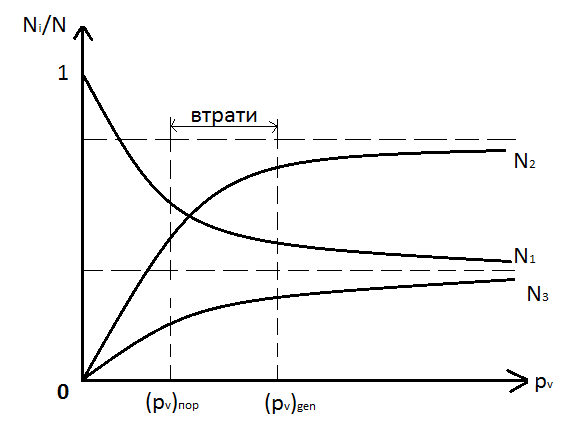
Рисунок 2. Залежності вiдносної заселеностi рiвнiв вiд спектральної густини енергії накачування
Розділ 2. Теоретичні відомості про лазери Завдання 2
Metal Vapor Lasers
Approximately 75 to 80 visible laser transitions have been reported in vapors of over 30 elements. These range from the first ion laser discovered, which was in mercury vapor where oscillation occurs in the red portion of the spectrum at 615.0 nm, to the helium-cadmium laser which oscillates at 441.6 nm at the blue end of the visible spectrum. Other well-known metal vapor lasers include the pulsed copper laser at 510.5 and 578.2 nm and the gold vapor laser at 627.8 nm. Pulsed visible lasers in strontium ions at 407.7, 416.2, and 430.5 nm have also been developed. A laser with perhaps one of the broadest spectral output ranges is the helium-selenium laser producing over 35 laser transitions in the visible spectrum ranging from 446.7 to 653.4 nm.
Helium-Cadmium Laser. The cw He-Cd laser, operating at 441.6 and 325.0 nm, is probably the best known and most widely used metal vapor laser. The blue transition3 is the shortest-wavelength visible laser available commercially, and the 325.0-nm uv laser was the shortest-wavelength cw uv laser for many years (until a number of transitions in the 200 to 300-nm region were developed in Ar2+ and Ar3+ by operating those lasers at very high currents and by improving the quality of the cavity mirrors). A number of other laser transitions have also been developed in the helium-cadmium discharge. The most significant of these are the transitions at 537.8 and 533.7 nm in the green and at 636.0 nm in the red. These transitions operate most effectively under different plasma conditions than the blue and uv lasers and generally are optimized with a different type of discharge tube, known as a hollow cathode tube. When all of these blue, green, and red transitions are made to lase simultaneously, the resultant output is a white light laser which for many years was investigated for use in color copying systems.
The blue and uv lasers are operated primarily in a positive column type of dc discharge at currents in the range of 60 to 70 mA in a 1 to 2-mm-bore glass discharge tube. The operation of these lasers is more like that of the He-Ne laser than the noble gas ion lasers. A relatively low current and relatively high gas pressure are required and, therefore, in most lasers no supplemental cooling requirements are necessary. Some models do, however, use a small cooling fan. Typical bore lengths are of the order of 25 to 30 cm with a voltage drop from anode to cathode of over 1000 V. The laser tube is filled with helium gas at a pressure of approximately 5 to 7 Torr and the Cd is fed into the discharge from a side reservoir by a process known as cataphoresis. In this process Cd is vaporized at the anode end of the tube and migrates toward the cathode, where it recondenses in an unheated region of the glass tube. The cataphoresis effect results from the relatively high degree of ionization of Cd in the discharge (primarily Cd+) and the force the electric field within the plasma exerts upon those ions, thereby pulling them toward the cathode. A few grams of Cd are sufficient to provide up to 5000 h of continuous operation of the laser.
The single-mode blue laser power is typically 15 to 20 mW for the 25 to 30-cm-long discharge. Each laser tube is fitted with a He reservoir in order to replace the helium that is gradually lost, both by diffusion through the tube walls and also by being captured as the Cd condenses in the unheated cathode regions. The He pressure is electronically monitored and adjusted for optimum laser output.
Higher-power versions of this laser are developed by connecting two of the smaller tubes together to share a common cathode, effectively doubling the gain length and thereby sig nificantly increasing the available power. Such tubes offer cw powers of the order of 75 to 100 mW at 441.6 nm.
The blue and uv transitions in Cd are somewhat unique spectroscopically, when compared with other laser transitions, because they involve an inner shell electronic configuration. The upper laser level configuration is 4d95s2 whereas the lower laser level is 4d105p. Consequently when electronic transitions occur between these levels, two electrons must change their momentum state, with one 5s electron jumping to fill the 4d shell and the other changing to 5p. Such a transition is therefore less likely to occur than a more typical visible electronic transition that requires only one electron change. These specific Cd+ transitions have a relatively long radiative lifetime (—700 ns) and a relatively low stimulated-emission cross section of 4 X 10-14cm2. The gain coefficient at 441.6 nm is typically 0.0003 cm, which is significantly higher than that of the He-Ne laser.
The unique electronic configuration for these transitions also leads to a large isotope spectral shift at 441.6 nm for different Cd isotopes. Naturally occurring metallic Cd is composed of several isotopes, and the isotope shift between adjacent even isotopes is of the order of the Doppler width (1.1 GHz). The most abundant isotopes are Cd 110 (12 percent), Cd 111(13 percent), Cd 112 (24 percent), Cd 113 (12 percent), Cd 114 (29 percent), and Cd 116 (8 percent). Consequently, since most lasers typically use naturally occurring Cd, the spectral output of the laser is significantly broader than just the Doppler width of a single isotope. Often only the two strongest isotopes, Cd 112 and Cd 114, are involved in the laser output, which provides a combined bandwidth of 2.6 GHz for the gain medium.
The unique electronic configuration also leads to unique excitation mechanisms, as indicated in Fig. 4.5. Several have been identified for these laser transitions. The first mechanism identified is a process known as Penning ionization in which highly excited (usually metastable) helium atoms transfer their energy to Cd, in a way similar to the operation of the He-Ne laser. However, in the case of Cd, ions are produced by the process, instead of excited neutral atoms as in the case of neon, owing to the much lower ionization potential of Cd than of Ne. In Cd, the ejected electron in the ionization process takes up the excess energy mismatch between the initially excited He atom and the resulting Cd+ ionized level. This collisional transfer process is particularly enhanced in Cd since only a single d electron has to be removed from the Cd neutral ground state (4d105s2) during the collision to result in the population of the Cd+ upper laser level (4d95s2).
The second mechanism is a two-step electron collisional excitation where the first electron collision produces Cd+ ion ground states and the second electron collision produces the Cd+ upper laser level (similar to the Ar+ excitation). The two-step electron ionization and the Penning process are the major excitation mechanisms for the conventional He-Cd laser. There is still some question as to which process dominates under various conditions of operation.
The third mechanism, more recently identified, is the photoionization of the Cd atom using very-short-wavelength photons (soft x-rays). For example, when Cd vapor at a pressure of the order of 1 Torr is irradiated with photons of wavelengths ranging from 10 to 70 nm, those photons will directly excite only Cd+ ions in the upper laser level (4d95s2). This process was first shown to occur by pumping Cd vapor with short-wavelength laser-produced plasma sources, but it also operates in the He-Cd discharge plasma tube because of the presence of significant He emission in the 30 to 60-nm spectral region during operation of the He-Cd laser. The mechanism is believed to play only a minor role in the operation of the positive column He-Cd laser owing to the relatively low density of Cd for optimum laser output, which allows most of the soft-x-ray emission to escape from the discharge before being absorbed by Cd atoms.