Материал: искусственный интеллект

suai.ru/our-contacts |
quantum machine learning |
16 D. Aerts et al.
modeling is intrinsically built upon complex vector spaces (Hilbert spaces), where linearity works directly at the level of the complex numbers and weights are only obtained from the square of their moduli. In other words, the complex numbers rj eiρj , appearing in the expansion (7), can be understood as generalized coefÞcients ψ , and
expressing a connection between the meaning carried by the QWeb in state | |
8 |
|
||||
the meaning Òsticking outÓ from (the stories contained in) the webpages Wj . |
|
|
||||
As a very simple example of initial state, we can consider a state |
| |
χ |
expressing a |
|||
1 |
|
n |
|
|
||
uniform meaning connection towards all the Web stories: |χ = |
√ |
|
|
j =1 eiρj |
|ej , |
|
n |
|
|||||
so that the probability to obtain story Wi , in a Ôtell a story measurementÕ, when the QWeb is in such uniform state |χ , is:
|
|
|
1 |
n |
|
|
|
|
|
|
|
|
1 |
|
|
|
|
|||
|
|
|
|
ei(ρj −ρk ) |
|
|
|
|
|
|
|
|
|
|
|
|||||
|
|
|
μ(Wi ) = χ |Pi |χ = |
|
|
e |
k |ei |
|
ei |e |
j |
= |
|
. |
|
|
(8) |
||||
|
|
|
n |
j,k=1 |
n |
|
|
|||||||||||||
|
|
|
|
|
|
|
|
|
|
|
|
|
|
|
||||||
|
|
|
|
|
|
|
δki |
|
|
δij |
|
|
|
|
|
|
|
|||
As |
another simple example, we can |
consider the |
QWeb state |
|
χ |
= |
||||||||||||||
1 |
|
|
|
|
|
|
|
|
|
|
|
|
|
|
|
|
| I |
|||
|
√ |
|
j I eiρj |ej , which is uniform only locally, i.e., such that only a subset I |
|||||||||||||||||
|
m |
|||||||||||||||||||
of m webpages , with m ≤ n, would have the same (non-zero) |
probability of being |
|||||||||||||||||||
|
|
|
|
1 |
|
|
||||||||||||||
selected as an actual story, so that in this case μI (Wi ) = χI |Pi |χI = |
|
, if i |
I , |
|||||||||||||||||
m |
||||||||||||||||||||
and zero otherwise. |
|
|
|
|
|
|
|
|
|
|
|
|
|
|
|
|
||||
It is important to observe that we are here viewing the QWeb as a whole entity, when we speak of its states, although it is clearly also a composite entity, in the sense that it is a complex formed by the combination of multiple concepts. Take two concepts A and B (for example, A = Fruits and B = Vegetables). As individual conceptual entities, they are certainly part of the QWeb composite entity, and as such they can also be in different states, which we can also write as linear combinations of the webpagesÕ basis states:
|ψA = |
n |
|ψB = |
n |
bj eiβj |ej , |
|
|||
aj eiαj |ej , |
j =1 |
(9) |
||||||
|
j =1 |
|
|
|
|
|
|
|
with aj , bj , αj , βj R, aj , bj ≥ 0, and |
n |
2 |
= |
n |
2 |
= 1. These states, |
||
j =1 aj |
j =1 bj |
|||||||
however, will be considered to be also states of the QWeb entity as a whole, as they also belong to its n-dimensional Hilbert space. In other words, even if states are all considered to be here states of the QWeb entity, some of them will also be interpreted as describing more speciÞc individual conceptual entities forming the QWeb. We thus consider that individual concepts forming the composite QWeb entity can be viewed as speciÞc states of the latter. Of course, the quantum formalism also offers another way to model composite entities, by taking the tensor product of the Hilbert spaces of the sub-entities in question. This is also a possibility, when
8More precisely, the real positive number rj can receive a speciÞc interpretation as quantum meaning bonds; see Appendix 2.
suai.ru/our-contacts |
quantum machine learning |
Modeling Meaning Associated with Documental Entities: Introducing the. . . |
17 |
modeling conceptual combinations, which proved to be very useful in the quantum modeling of data from cognitive experiments, particularly in relation to the notion of entanglement (see [6, 7] and the references cited therein), but in the present analysis we focus more directly on the superposition principle (and the interference effects it subtends) as a mechanism for accounting for the emergence of meaning when concepts are considered in a combined way [2] (see however the discussion in the Þrst part of Sect. 5).
Since we are placing ourselves in the same paradigmatic situation of the doubleslit experiment, we want to consider how the combination of two concepts A and BÑlet us denote the combination ABÑcan manifest at the level of the Web stories, in the ambit of a Òtell a story measurement.Ó Here we consider the notion of Òcombination of two conceptsÓ in a very general way, in the sense that we do not specify how the combination of A and B is actually implemented, at the conceptual level. In human language, if A is the concept Fruits and B is the concept Vegetables, their combination can, for instance, be Fruits–vegetables, Fruits and vegetables,
Fruits or vegetables, Fruits with vegetables, Fruits are sweeter than vegetables, etc., which of course carry different meanings, i.e., describe different states of their two-concept combination. In fact, also stories which are jointly about Fruits and Vegetables can be considered to be possible states of the combination of these two concepts. All these possibilities give rise of different states |ψAB , describing the combination of the two concepts A and B.
These two concepts can be seen to play the same role of the two slits in the double-slit experiment. When the two slits are jointly open, we are in the same situation as when the two concepts A and B are jointly considered in the combination AB, producing a state |ψAB that we can describe as the superposition of two states |ψA and |ψB , which are the states of the concepts A and B, respectively, when considered not in a combination, and which play the same role as the states of the electron in the double-slit experiment traversing the barrier when only one of the two slits is kept open at a time. Of course, different superposition states can in principle be deÞned, each one describing a different state of the combination of the two concepts, but here we limit ourselves to the superposition (5), where the states |ψA and |ψB have the exact same weight in the superposition.
Let now X be a given concept. It can be a concept described by a single word or a more complex concept described by the combination of multiple concepts. We
consider the projection operator Mw , onto the set of states that are manifest stories |
||
X |
|
|
about X. This means that we can write: |
|
|
MXw = |
|ei ei |, |
(10) |
i JX |
|
|
where JX is the set of indexes associated with the webpages that are manifest stories about X, where by ÒmanifestÓ we mean stories that explicitly contain the word(s) ÒXÓ indicating the concept X, hence the superscript ÒwÓ in the notation, which stands for Òword.Ó Indeed, we could as well have deÞned a more general projection
suai.ru/our-contacts |
quantum machine learning |
18 |
D. Aerts et al. |
operator MXs = |
i IX |ei ei |, onto the set of states that are stories about X not |
necessarily of the manifest kind, i.e., not necessarily containing the explicit word(s) indicating the concept(s) the stories are about, with JX IX , and the superscript ÒsÓ now standing for Òstory.Ó
To avoid possible confusions, we emphasize again the difference between the notion of state of a concept and that of story about a concept. The latter, in our deÞnition, is a webpage, i.e., a full-ßedged printed or printable document. But webpages that are stories about a concept may explicitly contain the word indicating such concept or not. For example, one can conceive a text explaining what Fruits are, without ever writing the word ÒfruitsÓ (using in replacement other terms, like Òfoods in the same category of pineapple, pears, and bananasÓ). On the other hand, the notion of state of a concept expresses a condition which cannot in general be reduced to that of a story, as it can also be a superposition of stories of that concept (or better, a superposition of the states associated with the stories of that concept), as expressed, for instance, in (7) and (9), and a superposition of (states of) stories is not anymore a (state of a) story.
Now, when considering a Òtell a story measurement,Ó we can also decide to only focus on stories having a predetermined content. In the double-slit experiment, this would correspond to only be interested in the detection of the electron by a certain subset of cells, indicated by a given set of indexes JX , and not the others. More speciÞcally, we can consider only those stories that are Òstories about X,Ó where X is a given concept. This means that if the QWeb is in a pre-measurement state |ψA , which is the state of a given concept A, what we are asking through the measurement is if the stories about X are good representatives of A in state |ψA (in the same way we can ask if a certain subset of traces of impact, say those of the central fringe, is a good example of electrons passing through the left slit; see the discussion of Sect. 3). In other words, we are asking how much |ψA is meaning connected to concept X, when the latter is in one of the maximally concrete states deÞned by the webpages that are Òstories of XÓ or even more speciÞcally Òmanifest stories of X.Ó
In the latter case, we can test this by using the projection operator MXw and the Born rule. According to (4), the probability μA with which the concept A in state |ψA is evaluated to be well represented by a Òmanifest story about XÓ is given by the average:
μA(i JX ) = ψA|MXw |ψA = |
| ei |ψA |2 = |
ai2, |
(11) |
|
i JX |
i JX |
|
where for the last equality we have used (9). If we additionally assume that A is more speciÞcally described by a state that is a superposition only of those stories that explicitly contains the words ÒAÓ (manifest stories about A), the above probability becomes (omitting from now on the argument, to simplify the notation): μA = i JA,X ai2, where JA,X denotes the sets of indexes associated with the webpages jointly containing the words ÒAÓ and ÒX.Ó Note that if nA,X = |JA,X | is the number of webpages containing both terms ÒAÓ and ÒX,Ó nA = |JA| and nX = |JX | are the webpages containing the ÒAÓ term and the ÒXÓ term, respectively, we have nA,X ≤

suai.ru/our-contacts |
quantum machine learning |
Modeling Meaning Associated with Documental Entities: Introducing the. . . |
19 |
nA and nA,X ≤ nX . Becoming even more speciÞc, we can consider states of A expressing a uniform meaning connection towards all the different manifest stories about A, that is, characteristic function states of the form:
1 |
|
eiαj |ej , |
|
|
|
||||
|χA = |
√ |
|
|
|
|
(12) |
|||
nA |
j |
|
|
||||||
|
|
|
JA |
|
|
|
|
||
for which the probability (11) becomes: |
|
|
|
|
|
|
|
||
μA = χA|MXw |χA = |
1 |
= |
nA,X |
, |
(13) |
||||
|
nA |
nA |
|||||||
|
|
|
|
i JA,X |
|
|
|
|
|
which can be simply interpreted as the probability of randomly selecting a webpage containing the term ÒX,Ó among those containing the terms ÒA.Ó
With respect to the double-slit experiment analogy, the probability μA describes the Òonly left slit openÓ situation, and of course, mutatis mutandis, we can write
(with obvious notation) an equivalent expression for a different concept B: μ |
= |
||||||
w |
|
1 |
|
nB,X |
B |
||
χB |MX |
|χB = |
i JB,X |
|
= |
|
. So, when calculating the probability μAB for |
|
nB |
nB |
||||||
the combination AB of the two concepts A and B, we are in a situation equivalent to when the two slits are kept jointly open, with the question asked being now about the meaning connection between AB, in state |ψAB , and a (here manifest) story about X. Concerning the state |ψAB , describing the combination, we want it to be able to account for the emergence of meanings that can possibly arise when the two concepts A and B are considered one in the context of the other, and for consistency reasons we expect the probability μAB to be equal to (since we are here limiting our discussion, for simplicity, to manifest stories), where nAB is the number of webpages containing both the ÒAÓ and ÒBÓ terms and nAB,X is the number of webpages containing in addition also the ÒXÓ term, and of course: nAB,X ≤ nAB , nAB ≤ nA, and nAB ≤ nB . This can be easily achieved if the state of AB is taken to be the characteristic function state: |χAB =
however, coming back to our discussion of Sect. 2, this would not be a satisfactory way to proceed, as the modeling would then remain at the level of the canvas of printed documents of the Web, and would therefore not be able to capture the level of meaning associated with it, that is, the more abstract QWeb entity. It is only at the level of the latter that emergent meanings can be explained as the result of combining concepts.
By analogy with the paradigmatic double-slit experiment, we will here assume that a state of AB, i.e., a state of the combination of the two concepts A and B, when they are in individual states |ψA and |ψB , respectively, can be generally represented as a superposition vector (5). Since here we are considering the special case where these states are characteristic functions, we more speciÞcally have:
1
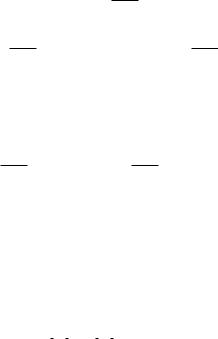
|ψAB = √ (|χA + |χB ), (14) 2
suai.ru/our-contacts |
quantum machine learning |
20 D. Aerts et al.
where we have assumed for simplicity that |χA and |χB can be taken to be orthogonal states (this need not to be the case in general). The interference
contribution IntAB = |
|
χA|MXw |χB can then be calculated by observing that: |
||||||||||||||
MXw |χB = |
|
|
|ej ej | |
1 |
|
|
|
|
eiβk |ek |
|
||||||
|
|
|
√ |
|
|
|
|
|
|
|||||||
|
|
|
nB |
|
||||||||||||
|
|
j JX |
|
|
|
|
k JB |
|
||||||||
|
|
1 |
|
|
|
|
1 |
|
||||||||
= |
√ |
|
|
eiβk |ej |
ej |ek |
= |
√ |
|
eiβj |ej , (15) |
|||||||
nB |
j JX k JB |
nB |
||||||||||||||
|
|
|
||||||||||||||
|
|
|
|
|
|
|
|
δj k |
j JB,X |
|||||||
so that, multiplying the above expression from the left by χA| and taking the real part, we obtain:
IntAB = |
1 |
|
e−iαj ej | |
|
|
1 |
|
|
|
eiβk |ek |
||||||||||||||||
|
|
√ |
|
|
|
|
|
|
√ |
|
|
|
|
|
||||||||||||
|
|
nA |
|
|
nB |
k JB,X |
||||||||||||||||||||
|
|
|
|
|
|
j JA |
|
|
|
|
|
|
|
|
|
|
|
|
|
|
|
|
|
|||
= |
1 |
|
|
|
e |
j | |
e |
|
|
|
|
ei(βk −αj ) |
= |
|
cos(βj − αj ) |
. (16) |
||||||||||
√ |
|
|
|
|
k |
|
|
√ |
|
|
||||||||||||||||
nAnB |
|
|
|
|
|
|
|
|
|
|
|
|
nAnB |
|
||||||||||||
|
|
|
|
|
cos(βk −αj ) |
|||||||||||||||||||||
|
|
|
|
|
|
|
||||||||||||||||||||
|
|
|
|
|
j JA k JB,X |
|
δj k |
|
|
|
j JAB,X |
|||||||||||||||
According to (6), (13), and (16), the probability μAB for the combined concept AB is therefore:
μ |
AB = |
1 |
|
nA,X |
+ |
nB,X |
+ |
|
cos(βj − αj ) |
. |
(17) |
|||
2 |
|
nA |
|
nB |
√ |
|
|
|||||||
|
|
|
|
nAnB |
|
|
||||||||
|
|
|
|
μA |
|
|
μB |
|
j JAB,X |
|
||||
|
|
|
|
|
|
|
|
|
|
|
|
|
||
It is important to observe in (17) the role played by the phases αj |
and βj |
|||||||||||||
characterizing the states |χA and |χB . When they are varied, the individual probabilities μA and μB remain perfectly invariant, whereas the values of μAB
can explore an entire range of |
values, within |
the |
interference interval I |
AB |
= |
||||||||
[μABmin, μABmax], where according to (17) we have: |
|
|
|
|
|||||||||
μABmin = |
1 |
|
|
nA,X |
+ |
nB,X |
− |
nAB,X |
|
|
|
||
|
|
|
|
|
|
√ |
|
, |
|
|
|||
2 |
|
|
nA |
nB |
|
|
|||||||
|
|
nAnB |
(18) |
||||||||||
|
1 |
|
|
nA,X |
|
nB,X |
|
nAB,X |
|
||||
μABmax = |
|
|
+ |
+ |
|
|
|
||||||
|
|
|
|
|
|
√ |
|
. |
|
|
|||
2 |
|
|
nA |
nB |
|
|
|||||||
|
|
nAnB |
|
|
|||||||||
Therefore, we see that via the interference effects, the co-occurrence of the terms ÒA,Ó ÒB,Ó and ÒXÓ is independent of what is revealed in the Web for the cooccurrence of just ÒAÓ and ÒXÓ or the co-occurrence of just ÒBÓ and ÒX.Ó This