Материал: искусственный интеллект

suai.ru/our-contacts |
quantum machine learning |
The Power of Distraction: An Experimental Test of Quantum Persuasion |
27 |
him. Next, in [6] the same authors investigate a short sequence of measurements but in the frame of a simpler task that they call “targeting”. The object of “targeting” is the transition of a belief state into another specified target state. The main results of relevance to our issue is that distraction providing ‘not relevant’ or ‘incompatible’ information has significant persuasion power. This is in sharp contrast with the Bayesian context where such information should have minimal or no e ect at all.
The present paper aims at testing experimentally those predictions. More precisely, we want to test whether a question (a measurement) addressing a perspective that is incompatible with the information relevant for the decision at stake can a ect decision-making. That is we test the concluding statement in Akerlof and Shiller’s book (see [1]) “just change the focus of people’s mind and you change the decisions they make”.
In the psychology literature, the distraction e ect was first introduced by Festinger and Maccoby in [9]. Its link with persuasion has now proved empirically valid through many di erent experimental contexts (for a review, [2]).1 Interestingly studies (see [16]) have shown how a noninformative signal can decrease documented resistance to persuasion (see [8]). In addition, across five di erent experimental contexts and content domains, Kupor and Tormala revealed in [14] that interruptions that temporarily disrupt(distract) a persuasive message can increase consumers’ processing of that message; consumers being more persuaded by interrupted messages than they would be by the exact same messages delivered uninterrupted.
The situation that we consider is the following. People are invited to choose between two projects aimed at saving endangered species (Elephants and Tigers). The selected project will receive a donation of 50e(one randomly selected respondent will determine the choice). We consider two perspectives of relevance for the choice: the urgency of the cause and the trustworthiness (or honesty) of the organization that manages the donations. As a first step, in a separate experiment we establish that the two perspectives are incompatible by exhibiting a significant order e ect (as in [3, 17]. In the main experiment, respondents were divided into three groups: a control and two treatment groups. They all go through a presentation of the projects and some questions about their preferences. The di erence between the groups is that the first treatment group receives general additional information compatible with their (elicited) preferences while the second one receives general additional information incompatible with their preferences.
The results are in accordance with the predictions of the theoretical model: incompatible information has a significant impact such that the respondents on the whole switched their choice as compared with the control. Compatible
1Decades of research on social influence have emphasized two distinct routes to persuasion: the “central” route and the “peripheral” route. According to Petty and Cacioppo in [16], the central route involves influence that takes place as a result of relatively deep processing of information that is high in message relevance, whereas the peripheral route involves influence that takes place as a result of relatively superficial processing of information that is low in message relevance.

suai.ru/our-contacts |
quantum machine learning |
28 A. Lambert-Mogiliansky et al.
information has globally no impact compared to the control group. None of the population variable has any impact. This suggests that the quantum model may indeed capture basic regularities of the mind relevant to decision-making.
2 The Quantum Persuasion Approach
Let us first briefly describe the classical approach (Bayesian persuasion) developed by Kamenica and Gentzkow [12]. We have a person call him Sender who tries to influence a decision-maker call her Receiver by means of an information structure or a measurement that generates information. Information a ects Receiver’s beliefs which in turn a ect her evaluation of uncertain choice alternatives and therefore the choice she makes. In the classical context Receiver updates her beliefs using Bayes rule and therefore the power of Sender is constrained by Bayesian plausibility - that is the expected posteriors must equal the priors.
The quantum persuasion approach has been developed in the same vein as the Bayesian persuasion. A central motivation is that persuasion seems much more e ective than what comes out of the Bayesian approach. So instead of assuming that agents are classical, it has been proposed that they are quantum-like. This means that the representation of reality upon which they make decision does not evolved according to Bayes rule but follows instead von Neumann-L˝uder’s rule (vNL). vNL updating has been shown to be an expression of dynamic consistency in such a context (see [7]).
The present paper aims at experimentally testing some predictions of the theory of quantum persuasion. More precisely as shown in [6], Sender can use ‘distracting’ measurements as tools to influence Receiver. A distracting measurement corresponds to a measurement that generates information that is incompatible (or Bohr complementary) with the information used by Receiver to evaluate the choice alternatives for decision-making. The objective is to switch the focus of Receiver’s mind (distract her) which changes her cognitive state or her beliefs although no information relevant to her concern is provided. The following example from [5] illustrates the point.
Example
A consumer is considering the purchase of a second hand smartphone at price 30eof uncertain value to her. What matters to her is its technical quality which may be standard or excellent. She holds beliefs about the quality of the smartphone. Based on those beliefs, she assigns an expected utility value to the smartphone which determines her decision whether or not to buy the item. Receiver’s expected utility for the smartphone in belief state B is represented by the trace of the product of operators A and B2:
Eu (A; B) = Tr (AB) = (1/5) 100 + (4/5) 0 = 20 < 30. |
(1) |
Given belief B Receiver does not want to buy the smartphone.
2 For a complete formulation of choice theory in the quantum context, see [7].
suai.ru/our-contacts |
quantum machine learning |
The Power of Distraction: An Experimental Test of Quantum Persuasion |
29 |
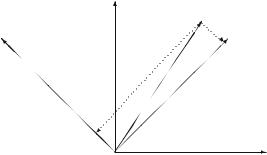
Can Sender persuade Receiver to buy by selecting an appropriate measurement? Consider another property (perspective) of the smartphone that we refer to as Glamour (i.e. whether celebrities have this brand or not). The two properties (perspectives) are assumed incompatible in the mind of Receiver. Receiver can think in terms of either one of the two perspectives but she cannot synthesize (combine in a stable way) pieces of information from the two perspectives. This is illustrated in Fig. 1.
|
e2 |
|
B |
B = |NG |
B = |G |
|
e1 |
Fig. 1. Receiver’s cognitive state.
Assume that Sender brings up the discussion to the Glamour perspective and performs the measurement so Receiver learns whether her preferred celebrity has this smartphone. With some probability p (say 0.9) the new cognitive state is B = G and with the complementary probability 1 − p = .1 it is B = N G.
We note that:
Eu (A; B ) = Tr (AB ) = 50 > 30. |
(2) |
Eu (A; B ) = Tr (AB ) = 50 > 30. |
(3) |
In both cases Receiver is persuaded to buy and Sender gets a positive utility. In the example above it is easy to show that the new belief state violates
Bayesian plausibility - the expected posteriors for the event ‘the smartphone is excellent’ are:
5p + .5(1 − p) = .5 |
(4) |
which is larger than the priors which equals 0.2. Moreover the measurement Glamour is not relevant to the beliefs about the quality of the used smartphone. It is a distraction. Yet it a ects the beliefs and the associated decision. In a Bayesian context irrelevant/uninformative data do not modify beliefs and therefore cannot be used as means of persuasion.

suai.ru/our-contacts |
quantum machine learning |
30 A. Lambert-Mogiliansky et al.
3 Experimental Design
Our main experiment uses the property of Bohr complementarity of mental perspectives, i.e., their possible incompatibility in the mind of Receiver. More precisely it relies on the hypothesis that two perspectives of interest are incompatible. The two perspectives that we consider are “the urgency of the task” (Urgency) and the “trustworthiness (Honesty)3 of the organization that manages the funds”. As a first step we want to provide support for this hypothesis. Two properties are incompatible if measuring them in di erent orders yields different results. Therefore, we started with an experiment to check whether order matters for the response profile obtained.4
3.1Testing for Perspective Incompatibility
295 participants completed a short survey on the website Typeform. They were recruited through Amazon’s Mechanical Turk; for which data quality has been confirmed by di erent studies (see [13]). They were paid $0.1 and spent on average 0:17 min to complete the survey.
Participants were first presented a short description of the situation of refugees in Myanmar with mention of the main humanitarian NGO present on the field.
“About a million refugees (a majority of women and children) escaped persecution in Myanmar. Most of them fled to Bangladesh. The Bengali Red Crescent is the primary humanitarian organization that is providing help to the Rohingyas. They are in immediate need of drinkable water, food, shelter and first medical aid.”
They were then asked to evaluate the urgency of the cause and the trustworthiness of the NGO on a scale from 1 (“Not urgent” or “No trust”) to 5 (“Extremely urgent” or “Full trust”). The order of presentation of each question was randomized so that half of participants responded to the urgency question before trust (U-T), and the other half conversely (T-U).
The data were processed, cleaned and analyzed with Stata. Probit regression models were used to analyze the e ect of the order of the questions on the responses. In addition, because we were only interested in decision switches, responses were clustered into two groups: low level of urgency (resp. trust) (responses ≤ 3) and high level of urgency (resp. trust) (responses > 3).
The results show that the order of the question impacts significantly the responses given to both Urgency (p-value = .050)5 and Trust (p-value = .026).
This can be seen on Table 1.
There exists other (psychological) theories that account for order e ects such as primacy or recency e ects. Yet, the results indicate that there seems to exist
3The two terms are used interchangeably consistently with the definition given to honesty - see below.
4Note that even in Physics there is no theoretical argument for establishing whether two properties are compatible or not. This must be done empirically.
5Note that we consider significant a p-value that is exactly equal to .05.

suai.ru/our-contacts |
quantum machine learning |
The Power of Distraction: An Experimental Test of Quantum Persuasion |
31 |
||||
Table 1. Regression matrix for Order e ects |
|
||||
|
|
|
|
|
|
|
|
(1) |
(2) |
|
|
|
|
TRUST |
URGENCY |
|
|
|
|
|
|
|
|
|
Main |
−0.330 |
−0.323 |
|
|
|
ORDER |
(0.026) |
(0.050) |
|
|
p-values in parentheses
= p ≤ 0.05, = p ≤ 0.01,
= p ≤ 0.001
Notes. ORDER = 0 for U-T, ORDER = 1 for T-U
a primacy e ect for one question, but a recency e ect for the other. We thus rejected the primacy and recency explanations and in the remaining we view the two perspectives as incompatible.
3.2Quantum Persuasion
The participants were divided into three groups. Two treatment groups and a control group as explained below. All three groups were presented a screen with an introductory message, informing them that the questionnaire was part of a research project on quantum cognition and that they will contribute in deciding which one of two NGOs projects will receive a 50edonation. Presumably this created an incentive to respond truthfully. They were then asked to click on a button that would randomly assign them to a given condition. In all conditions, participants were shown a short text about elephants and tigers in association with an NGO working for their protection, namely the Elephant Crisis Fund (ECF) and Tiger Forever (TF).6 The order of presentation of the text was reversed for half of the subjects. This aimed at avoiding order e ects irrelevant to our point. The texts contained a brief description of the dramatic situations of elephants (resp. tigers) and of ongoing actions by the NGOs.
“Elephant crisis fund: A virulent wave of poaching is on-going with an elephant killed for its tusks every 15 min. The current population is estimated to around 700 000 elephants in the wild. Driving the killing is international ivory trade that thrives on poverty, corruption, and greed. But there is hope. The Elephant Crisis Fund closely linked to World Wildlife Fund (WWF) exists to encourage collaboration, and deliver rapid impact on the ground to stop the killing, the tra cking, and the demand for ivory.”
“Tiger Forever: Tigers are illegally killed for their pelts and body parts used in traditional Asian medicines. They are also seen as threats to human communities. They su er from large scale habitat loss due to human population
6Individually speaking, the Urgency and the Honesty perspectives could be di erent for a refugee problem compared to an endangered species one. However, we always compared the perspectives in light of a donation to an NGO. In addition, given the results, we thus do not consider that di erence to be significant.