Материал: Traffic indicators investigation
Traffic indicators investigation
Traffic indicators investigation
1. Theoretical information
flight airspace flow
Control Zone - a controlled airspace extending upwards from the surface of the earth to a specified upper limit, control and ATS of which is provided by appropriate ATS unit.
Terminal Control Area - a control area normally established at the confluence of ATS routes in the vicinity of one or more major aerodromes.main purpose of TMAs is the provision of safe flights for aircraft leaving system of ATS routes for landing at given airdrome or taking-off from the airdrome and entering the ATS routes system.required TMA dimensions are determined by provision of descend and landing approach conditions via the shortest way (straight-in approach) for aircraft, which passed entrance corridor at the upper established flight level for TMA till the transition level and moment of reaching CTR borders, taking into account aircraft performance characteristics for aircraft operating at this airdrome.in approach pattern is considered like the most economical and provides the TMA capacity almost corresponding to norm, but requires greater TMA dimensions.of TMA radius is performed according to formulas:
ТМА ³ дmax + Slate + Sdes + SCTR/2;
Slate = MC* (twl + treact);des = MCS*(Hent - HGPE)/vy,where:
дmax - error of determination by the crew of moment of flight over outer marker (the border of TMA);late - distance, of flight of aircraft from the moment of flight of outer marker to the moment of beginning of descent;
Sdes - distance of flight of the aircraft at the descending from Нent to НGPE;CTR - size of CTR from side of approach;
MC - true air speed of flight of the aircraft at the entrance in aerodrome zone;
twl - average time of occupancy of ATCo by a radio exchange with other crew;react - ATS system delay;
Нent - altitude (flight level) of entrance in aerodrome zone;
НGPE - glide slope entrance height;- forward speed of an aircraft at the descending from НВХ to НВГ;y - rate of descent of an aircraft from Нent to НGPE
ATS route - certain route assigned for directing traffic flow with the aim of ATS provision. This term is used for airways, controlled or uncontrolled routes, conditional routes, arrival and departure routes etc.
Airway - an airspace corridor with limited height and width and equipped with ground based navigation aids.
Air corridor - connection between ATS routes and control zone.
Types of air corridors:
· arrival (approach) to the aerodrome area;
· departure from the aerodrome area;
· mixed (arrival, departure).
Air Traffic - all aircraft at flight or moving in aerodrome manoeuvring zone.
Separation - intervals between aircraft, levels or tracks.
Flight Level - a surface of constant atmospheric pressure which is related to a specific pressure datum, 1 013.2 hectopascals (hPa), and is separated from other such surfaces by specific pressure intervals.1. A pressure type altimeter calibrated in accordance with the standard atmosphere:
1. when set to a QNH altimeter setting, will indicate altitude;
2. when set to a QFE altimeter setting, will indicate height above the QFE reference datum;
. when set to a pressure 1 013.2 hPa, may be used to indicate flight levels.2. The terms «height» and «altitude», used in Note 1 above, indicate altimetric rather than geometric heights and altitudes.
When we set QFE pressure it will show us a relative height over the aabutment point of QFE;we set pressure 760mm (1013,2 Hpa) it may be used for indication of flight levels;
Air traffic management - is a complex of ground and onboard facilities, that are necessary for provision of safety of flight during all its steps.
Air traffic service - flight information service, consultative service, emergency service, air traffic control service (approach air traffic control service, terminal air traffic control service, area air traffic control service)
Intensity of flight
- amount of aircraft
actually taken to a control.


 - amount of aircraft;-
average time of flight of aircraft in air traffic area;
- amount of aircraft;-
average time of flight of aircraft in air traffic area;
Density
of air traffic - amount of aircraft, that
are in 1 unit of volume of air traffic control zone.
 ;
;  ;
;
Load
of zone - amount of aircraft that are under control in the limits of given
zone simultaneously.

Coefficient of load of zone:

 - throughput.
Throughput of air traffic zone - amount of aircraft that can be serviced by air traffic control units of this zone in 1 unit of time with adherence of normative indications of safety of flights.
Throughput of air traffic controller - amount of aircraft that can be under control of air traffic controller in 1 unit of time taking into account direct procedures of control simultaneously.
Work load of air traffic controller - time needed to perform necessary technological procedures of air traffic control.
Factors that influence on commitment:
intensity of flights;
density of flights;
structure of zone (size, amount of routes, amount of points of intersection of routes)
characteristics of aircraft flows (directions of flows, relations of types of aircraft in flows) equipment of work place
air traffic management (features of work technology, amount of air traffic controllers in 1 zone, character of restrictions in airspace)
level of air traffic controller
work place management
regim of work and rest
character of work place environment
psychological and psycho-physical characteristics of air traffic controller
Coefficient
of work load of air traffic controller is
expressed by relation of time spent by air traffic controller to perform
technological procedures and total resource of time.

 - is obtained only when
we can calculate the time of operations.
Coefficient of work load of air traffic controller has to be placed in the limits ftom 0.2 to 0.85, normative
coefficient is 0.55. Relation
between commitment coefficient and main characteristics of flow of aircraft is
expressed by following equation:
- is obtained only when
we can calculate the time of operations.
Coefficient of work load of air traffic controller has to be placed in the limits ftom 0.2 to 0.85, normative
coefficient is 0.55. Relation
between commitment coefficient and main characteristics of flow of aircraft is
expressed by following equation:

 - time spent on voice
communication during aircraft aperations (ex.: climbing, descending)
- time spent on voice
communication during aircraft aperations (ex.: climbing, descending)
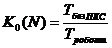
 - time spent on giving
of instructions to change FL, direction of flight, conflict situation,
conditions of flight.
- time spent on giving
of instructions to change FL, direction of flight, conflict situation,
conditions of flight.
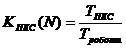
 - time spent on
information exchange between neighbour controllers, air traffic coordination,
work with strips and equipment of air traffic control system.
- time spent on
information exchange between neighbour controllers, air traffic coordination,
work with strips and equipment of air traffic control system.

2. Calculation
of TMA sizes
Manufactured type and modification
Speed
ROC
MC
MCS
AS
Boeing 767 - 300
895
405
260
18/8
Airbus 320
895
405
260
17/10
Fokker 100
840
370
260
7/4
IL-76
810
370
275
7/3
Yak 40
550
330
230
5/2
TMA 1 FL80 (2450m): RTMA ³ 4 +
6.5 + 36 + 19 ≈ 66 km; Slate =
248.6*(12 + 14) = 6.5 km; Sdes = 88.5*(2450 - 400)/5 = 36 km; Vdes= TMA 2 FL180 (5500m): RTMA ³ 4 + 6.5 + 90 + 21≈ 122 km; Slate = 248.6*(12 + 14) = 6.5 km; Sdes = 88.5*(5500 -
400)/5 = 90 km; Vdes= . Construction
of zone and flight plan
№
Route of flight
Entrance time
Entrance FL
ACFT type
Registration number
TRANSIT
1
МЮ-СК
08:00
390
B763
62501
2
ОВ-НМ-СУ
08:03
250
YK40
62502
3
ЕМ-БЕ-СУ
08:13
350
IL76
62503
4
ВК-БЕ-СК
08:25
360
IL76
62504
5
ЕМ-ЛП-СК
08:25
320
F100
62505
6
МЮ-ЕМ
08:30
430
B763
62506
7
СК-БЕ-ВК
08:32
320
F100
62507
8
ТВ-РТ-СУ
08:32
350
IL76
62508
9
ЕМ-МЮ
08:33
260
YK40
62509
10
СУ-БЕ-СК
08:34
390
A320
62510
11
СУ-РТ-ТВ
08:36
400
A320
62511
12
СК-МЮ
08:40
240
YK40
62512
13
ЕМ-БЕ-СУ
08:43
380
A320
62513
14
СК-БЕ-ВК
08:45
330
F100
62514
15
СК-ЕМ-ОВ
08:48
390
B763
62515
16
ОВ-ВК
08:50
240
F100
62516
17
МЮ-ЕМ
08:52
370
IL76
62517
18
МЮ-РТ-ЛП-ЕМ
08:55
330
F100
62518
19
СУ-НМ-ОВ
08:55
390
A320
62519
20
ЕМ-БЕ-СУ
08:59
400
B763
62520
TMA1 arrival
21
ВК-НМ-ДО
08:01
220/80/0
A320
32801
22
МЮ-БЕ-ДО
08:11
390/70/0
B763
32802
23
ОВ-НМ-ДО
08:26
160/30/0
F100
32803
24
СУ-НМ-ДО
08:38
100/60/0
YK40
32804
25
ВК-НМ-ДО
08:57
300/70/0
IL76
32805
TMA1 departure
26
ДО-БЕ-МЮ
08:04
0/80/320
B763
51301
27
ДО-НМ-ВК
08:06
0/40/90
F100
51302
28
ДО-НМ-ОВ
08:28
0/80/270
IL76
51303
29
ДО-БЕ-ЕМ
08:29
0/70/210
YK40
51304
30
ДО-БЕ-МЮ
08:55
0/80/360
B763
51305
TMA2 arrival
31
ТВ-РТ-АР
08:02
330/120/0
B763
15101
32
МЮ-РТ-АР
08:15
230/90/0
F100
15102
33
ЕМ-ЛП-АР
08:31
320/130/0
A320
15103
34
СК-ЛП-АР
08:45
250/100/0
IL76
15104
35
МЮ-РТ-АР
08:53
200/70/0
F100
15105
TMA2 departure
36
АР-РТ-ТВ
08:05
0/90/200
YK40
14005
37
АР-ЛП-СК
08:07
0/90/160
F100
14001
38
АР-РТ-ТВ
08:22
0/110/320
B763
14002
39
АР-РТ-МЮ
08:36
0/130/300
B763
14003
40
АР-ЛП-ЕМ
08:48
0/120/350 14004
4. Modeling of zone in experimental program «Potok»
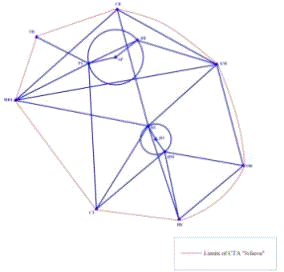
The experimental
controlled airspace «Ivlieva» at program «Potok» looks like:
Fig.5.1 The look of CTA
«Ivlieva» in program «POTOK»
the experiment has been
made, 1 conflict situation occurred within the limits of CTA (fig.5.2).
. Order one ACFT
to stop climb and another to stop descent until the creation of longitudinal
separation;
. To create
lateral interval by means of turning ACFT with less speed left or right on 30
degrees. After the creation of lateral interval to allow further climb or
descend, and after creation of VSM, return ACFT with less speed to the rout.
5. Analysis of
main flow direction of modeled airspace
flow direction:
Fig.6.1 Direction of
traffic flow
- 10% of flow has
direction 0°
2.5% of flow has
direction 30°
22.5% of flow has
direction 60°
5% of flow has direction
90°
2.5% of flow has
direction 120°
12.5% of flow has
direction 150°
7.5% of flow has
direction 180°
0% of flow has direction
210°
10% of flow has
direction 240°
10% of flow has
direction 270°
10% of flow has
direction 300°
7.5% of flow has
direction 330°to the flight levels:
FL 430 has main flow
direction 90°
FL 400 has main flow
direction which is divided 50/50 between 240° and 0°
FL 390 has main flow
direction 60°
FL 380 has main flow
direction 240°
FL 370 has main flow
direction 90°
FL 360 has main flow
direction 0°
FL 350 has main flow
direction 150°
FL 330 has main flow
direction 180°
FL 320 has main flow
direction 300°
FL 270 has main flow
direction 150°
FL 260 has main flow
direction 270°
FL 240 has main flow
direction which is divided 50/50 between 60° and 240°
FL 220 has main flow
direction 0°
FL 210 has main flow
direction 330°
FL 200 has main flow
direction 60°
FL 160 has main flow
direction 300°
FL 100 has main flow
direction 60°
FL 90 has main flow
direction 150°
. Determination
of density and intensity of the flow
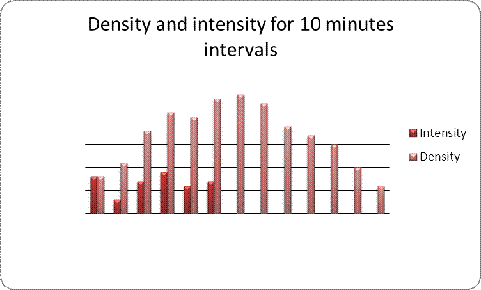
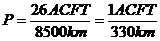
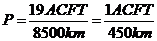
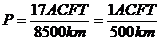
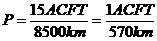
I have determined
density and intensity for 10 minutes intervals and constructed a histogram,
which contains information about density and intensity of traffic flow for
every 10 minutes of research (fig.7.1).
Fig.7.1 Density and
intensity for 10 minutes intervals
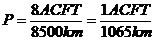
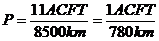
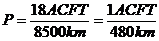
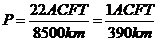
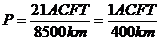
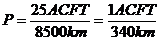
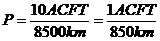
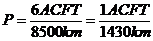
L route = 8500 kmat intervals:
- 00-10: - 11-20: - 21-30: - 31-40: - 41-50: - 51-60: - 61-70: - 71-80: - 81-90: - 91-100: - 101-110: - 111-120: - 121-130: The workload coefficient
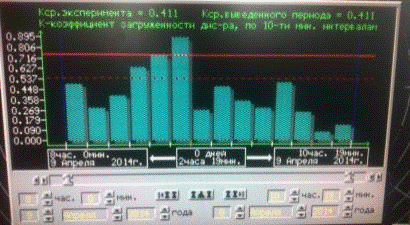
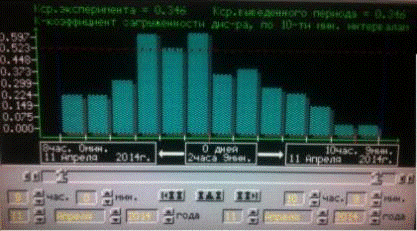
calculated in «POTOK» is shown on figure 7.2.
On the figure 7.2 there
is the ATCO workload coefficient for every 10 minutes. According to this
diagram:
- Average ATCO workload = 0.67;
- Min ATCO workload = 0.090;
- Max ATCO workload = 0.895.the analysis of results obtained above I
can make the conclusion that the ATCO is overloaded because there is a period
of time when the workload coefficient is greater than maximum acceptable.
That’s why I decided to divide CTA «Ivlieva» on two parts in horizontal plane
to decrease the workload of a controller.
7. Construction
of zone «Ivlieva_North», flight plan and ATCO workload
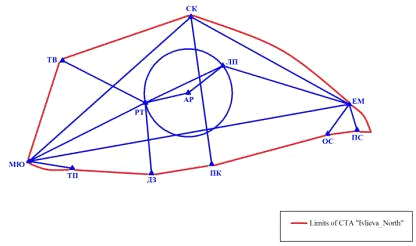
Fig.8.1 CTA
«Ivlieva_North» on scheme
8.1 Flight plan for CTA
«Ivlieva_North»
№
Route of flight
Entrance time
Entrance FL
ACFT type
Registration Number
TRANSIT
1
МЮ-СК
08:00
390
B763
62501
2
МЮ-ТП
08:11
390
B763
32802
3
ЕМ-ОС
08:13
350
IL76
62503
4
ЕМ-ЛП-СК
08:25
320
F100
62505
5
МЮ-ЕМ
08:30
430
B763
62506
6
СК-ПК
08:32
320
F100
62507
7
ТВ-РТ-ДЗ
08:32
350
IL76
62508
8
ЕМ-МЮ
08:33
260
YK40
62509
9
СК-МЮ
08:40
240
YK40
62512
10
ЕМ-ОС
08:43
380
A320
62513
11
СК-ПК
08:45
330
F100
62514
12
СК-ЕМ-ПС
08:48
390
B763
62515
13
МЮ-ЕМ
08:52
370
IL76
62517
14
МЮ-РТ-ЛП-ЕМ
08:55
330
F100
62518
15
ЕМ-ОС
08:59
400
B763
62520
16
ТП-МЮ
08:38
320
B763
51301
17
ДЗ-РТ-ТВ
09:07
400
A320
62511
18
ПК-СК
09:08
360
IL76
62504
19
ПК-СК
09:17
390
A320
62510
20
ТП-МЮ
09:29
360
B763
51305
TMA2 arrival
21
ТВ-РТ-АР
08:02
330/120/0
B763
15101
22
МЮ-РТ-АР
08:15
230/90/0
F100
15102
12
ЕМ-ЛП-АР
08:31
320/130/0
A320
15103
13
СК-ЛП-АР
08:45
250/100/0
IL76
15104
14
МЮ-РТ-АР
08:53
200/700/0
F100
15105
TMA2 departure
15
АР-ЛП-СК
08:07
0/90/160
F100
14001
16
АР-РТ-ТВ
08:22
0/110/320
B763
14002
17
АР-РТ-МЮ
08:36
0/130/300
B763
14003
18
АР-ЛП-ЕМ
08:48
0/120/350
B763
14004
19
АР-РТ-ТВ
08:05
0/90/200
YK40
14005
division of CTA lead to
the following:
Fig.8.3 The ATCO
workload in CTA «Ivlieva_North»
Thus, according to the
obtained results we see that the ATCO workload fell down and remained
acceptable during the all period.
8. Construction
of zone «Ivlieva_North», flight plan and ATCO workload
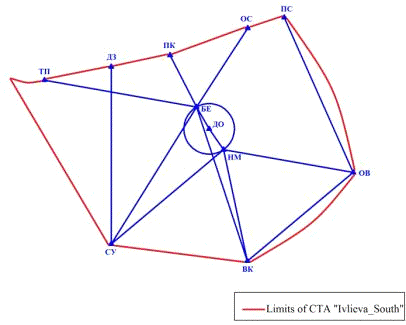
Fig. 9.1 CTA
«Ivlieva_South» on scheme
Table 9.1 Flight plan
for CTA «Ivlieva_South»
№
Route of flight
Entrance time
Entrance FL
ACFT type
Registration number
TRANSIT
1
ОВ-НМ-СУ
08:03
250
YK40
62502
2
ПК-БЕ-СУ
08:20
350
IL76
62503
3
ВК-БЕ-ПК
08:25
360
IL76
62504
4
ПК-БЕ-ВК
08:46
320
F100
62507
5
ОС-БЕ-СУ
08:49
380
A320
62513
6
СУ-БЕ-ПК
08:34
390
A320
62510
7
СУ-ДЗ
08:36
400
A320
62511
8
ОВ-ВК
08:50
240
F100
62516
9
СУ-НМ-ОВ
08:55
390
A320
62519
10
ОС-БЕ-СУ
09:05
400
B763
62520
11
ДЗ-СУ
09:06
350
IL76
62508
12
ПК-БЕ-ВК
09:14
330
F100
62514
13
ПС-ОВ 390
B763
62515
TMA2 arrival
14
ВК-НМ-ДО
08:01
220/80/0
A320
32801
15
ТП-БЕ-ДО
08:17
390/70/0
B763
32802
16
ОВ-НМ-ДО
08:26
160/30/0
F100
32803
17
СУ-НМ-ДО
08:38
100/60/0
YK40
32804
18
ВК-НМ-ДО
08:57
300/70/0
IL76
32805
TMA2 departure
19
ДО-БЕ-ТП
08:04
0/80/320
B763
51301
20
ДО-НМ-ВК
08:06
0/40/90
F100
51302
21
ДО-НМ-ОВ
08:28
0/80/270
IL76
51303
22
ДО-БЕ-ОС
08:29
0/70/210
YK40
51304
23
ДО-БЕ-ТП
08:55
0/80/360
B763
51305
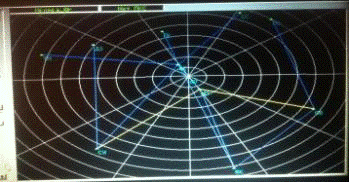
«Ivlieva_South» has a
following look:
Fig.9.2 The look of CTA
«Ivlieva_South» in program «POTOK»
We see that ATCO
workload fell down and became normal during the all period of time.
Conclusion
After the performance of
term work I analyzed obtained results and made the conclusion that the ATCO
workload depends on such traffic indicators as density, intensity, etc. That’s
why suitable planning of airspace structure leads to declining of workload which
reduces the possibility of conflicts and conflict situations appearance.
References
1. Terms of
aircraft operations and air traffic services in the classified airspace of
Ukraine: Order of the Ministry of Transport of Ukraine of 16.04.2003 №293 as
amended by the order of Ministry of Transport of Ukraine of 31.01.2004 p., №62.
(registered with the Ministry of Justice of Ukraine 23.02.2004, №238/8837) / /
Official Herald of Ukraine. - 2003. - №18.
. Doc 8643/37.
Aircraft type indicators: - 37th ed. - Montreal: ICAO, 2009.
. Doc 4444-ATM/501.
Air traffic management: - 15th ed. - Montreal: ICAO, 2007.
 SCTR/2 = 19 km; дmax = 4
km;
SCTR/2 = 19 km; дmax = 4
km;
SCTR/2 = 21 km; дmax = 4
km;
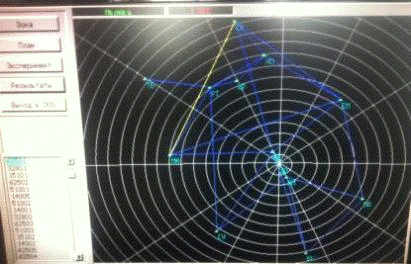
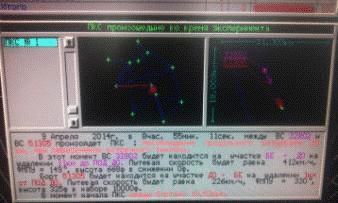 .5.2
The conflict situation
.5.2
The conflict situation
conflict situation has occurred in TMA1 zone on the segment БЕ-ДО. The horizontal
distance between ACFT at the moment of conflict was about 10.5 km. According to
nowadays standards, it is not the conflict because in TMA zone we use the 5NM
(9.3 km) separation minima. But as the program is old, the separation minimum
in its database equals 30 km. So, the following measures can be used to avoid
such conflict:


 .7.2
The ATCO workload
.7.2
The ATCO workload
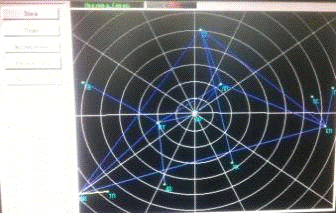 .8.2
The CTA «Ivlieva_North» in program «POTOK»
.8.2
The CTA «Ivlieva_North» in program «POTOK»
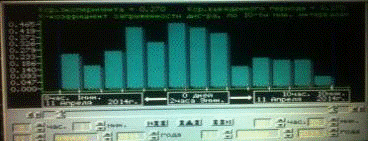 .9.3
The ATCO workload in the CTA «Ivlieva_South»
.9.3
The ATCO workload in the CTA «Ivlieva_South»