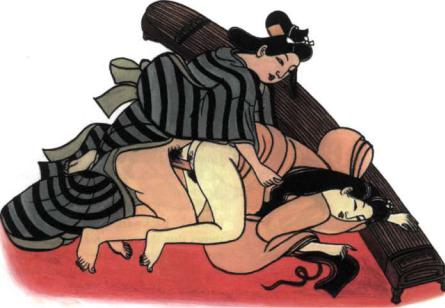
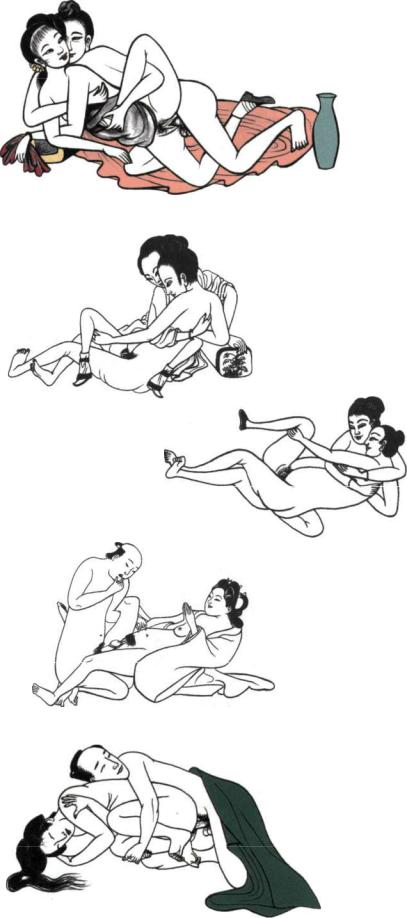
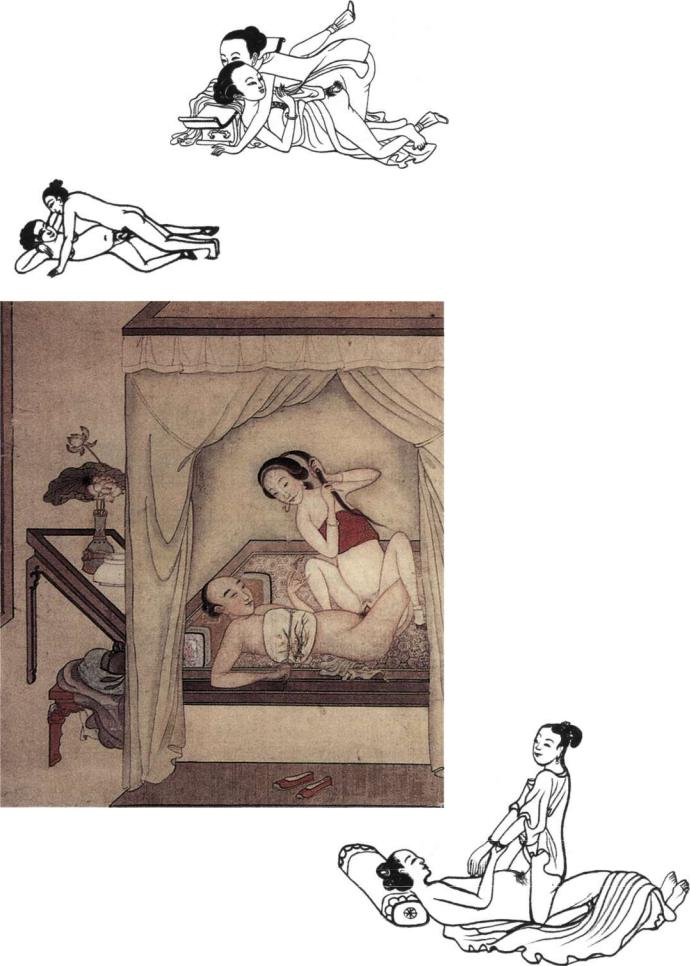
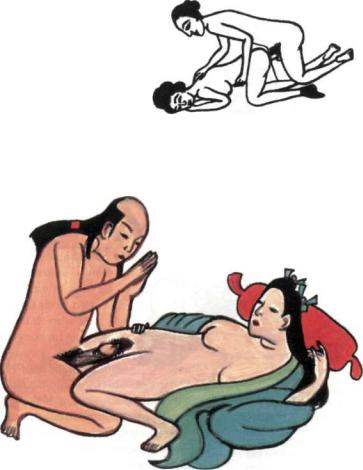
Therapeutic love-making was an ancient Taoist science. Through control of the rhythms and positions of love, vital elements of the body become harmonized. From a Japanese color print by Isoda Koryusai, circa 1772.
If one moves but does not emit semen, the life-force and vigor are in excess. The body absorbs the energy and all the senses are sharpened.
P'ENG TSU
T E N S T A G E S O F L O V I N G
The Plain Girl lists Ten Stages of Loving:
First, by embracing the man with her arms, a woman shows that she wants him to draw her body close and possess her in love. Second, by stretching out her legs, a woman shows the man that she wants him to rub the upper part of her Jade Gate [the clitoris]. Third, by stretching her stomach, she shows that she wants him to make short love-strokes in her body. Fourth, by beginning to move her buttocks backward and forward, she shows that she senses she will soon be experiencing great pleasure. Fifth, by raising her legs, she shows that she wants
therapeutic love-making
The Discourse of the Plain Girl lists the Eight Benefits from particular rhythms of lovemaking. These rhythms are mostly c o m b i n a t i o n s of magical numbers, taking the Yang Number as their inspiration. The Yang, or male force, is
represented by odd numbers and the Yin, or female force, by even ones.
Therapeutic love-making, by controlling the rhythms and positions of intercourse, is a topic unique to Oriental medicine. According to Eastern medical observation, the blood, flesh, fat, bones, marrow, and semen (or ovum) are links in a chain that evolves according to a natural order and rhythm. The
Sushruta Samhita, a major Hindu medical text, states, "Life-essence produces blood, from blood is produced flesh, from flesh originates fat, which gives rise to bones. From bones originates marrow, which in turn goes to generate semen or ovum." This sevenfold generation of bodily elements is a natural process that can easily be upset by over-exertion or unhealthful habits. Likewise it can be reinforced by a careful choice of actions.
him to penetrate into her body with deep love-strokes. Sixth, by squeezing her thighs together, she shows that her Jade Gateway is emitting love-juices. Seventh, by moving her body from left to right, she shows that she wants the man to penetrate into her body from the side. Eighth, by raising the upper part of her body and pressing her breasts against the man, she shows that she has almost reached her zenith of pleasure. Ninth, by relaxing her limbs, she shows that she has reached her climax. Tenth, by the emission of a copious flow of love-juices from her Precious Gateway, she shows that her vital essence has been released.
Therapeutic love-making draws its inspiration from the fact that specific postures channel energy in different ways, enabling the body to focus on and correct imbalances. Love-making is always linked to changes in respiration, heartbeat, circulation, glandular secretions, and brain waves. Since the body has the ability to create antidotes for any disease or condition, it is just a matter of triggering the correct metabolic process. Hatha Yoga postures and breathing have proved very effective in bringing the body to cure itself of even the most serious illnesses. Sexual Yoga can do this even more efficiently since both male and female principles are working in harmony and complementing each other.
Hatha Yoga by itself can be a lengthy and difficult discipline to perfect, whereas Taoist and Tantric love-making naturally generates vitality and energy.
Taoist and Tantric therapeutic love-making both emphasize rhythm and posture. These actions can benefit all parts of the male and female body and have a strengthening and lightening effect on the spirit. Though basically simple, this discipline does require that the man perfect his powers of retention. Woman's role in therapeutic love-making is that of an Initiatress invoking the nourishing powers of nature. Her emotional energy and subtle secretions are essential in bringing about harmonization of body and mind in her partner. While the man concentrates on retention, it is the woman's role to abandon herself to "giving," opening up the healing