Курсовая работа (т): Analysis of impact of exchange rate volatility on international trade
Analysis of impact of exchange rate volatility on international trade
Introduction
the present time globalization has becoming more significant and important phenomenon in the modern world, especially in the area of economic relations. The great example for this statement is the world economic crisis, which began in 2008. The main reason for this crisis is that the mortgage crisis happened in the USA in 2007, while it spread all over the world. The perceptible demonstration of globalization can be named the increase in the number of multinational corporations, the establishment of economic and politic unions (for instance, EAEU), etc. It is noteworthy to mention that the crucial role (even may be by the far the most important) role in international economic relations is played by exchange rates, because they have a direct impact on financial and trade flows between countries. For instance, in the case of depreciation of the national currency the country’s export will go up, given the fact that the price of export, denominated in foreign currency (US dollar) will decline for foreigners, while at the same time the country’s import will grow, because the price of import, denominated in national currency, will become higher for national consumers. It is essential to pay attention to the fact that not only the exchange rates, but also exchange rate volatility help to explain various economic situations, taking into account that the uncertainty has become a significant force, which influence crucially the economic sphere of society. This trend can help to explain the existence of a multitude of different theoretical and empirical works, devoted to the analysis of the impact of exchange rate volatility on various economic areas, including international trade.aim of this research consists in investigating the influence of exchange rate volatility RUB/USD on aggregate export of Russian Federation.into consideration the aim of this scientific work, it is possible to formulate following goals of the research:
) Considering the various theoretical models, related to the influence of exchange rate volatility on international trade
) Estimating the nominal exchange rate volatility RUB/USD by using ARCH model
) Constructing autoregressive
distributed lags model (ADL model) in which the export of Russian Federation
serves as a dependent variable, while explanatory variables include real
effective exchange rate index RUB/USD, Russian industrial production index and
estimated nominal exchange rate volatility RUB/USD.scientific work is organized
as follows: in the second section the literature survey of various works,
related to the influence of exchange rate volatility on international trade, is
represented; in the third section the data, used in this research, are
described in details, the empirical methodology, which serves as a base for
further empirical analysis, is considered and descriptive statistics of
investigating variables are calculated and the information about the movements
of nominal exchange rate volatility is visualized; in fourth section it is paid
attention to the main part of this work- empirical analysis; in the fifth
section some suggestions about future research, related to this topic, are
made, in the last part of this work the conclusion is drawn .
1. Review of literature, devoted to analysis of impact of exchange rate volatility on international trade
spite of the fact that that topic of
the influence of exchange rate volatility on international trade is relatively
new for economic literature, taking into account that this area of economic
thought is extremely actual for modern world economy, a multitude of different
theoretical, as well as empirical, articles and scientific works has been
already written. It is arduous to distinguish the common feature of these
works, because of their great variety: the existence of large amount of various
approaches to modeling the effect of exchange rate and different results of
empirical analysis, made by scientists in this field (positive, negative
effect, insignificant impact).of the first the most important works in the area
of investigating the influence of exchange rate volatility on international
trade is the article “The effect of exchange rate uncertainty on the prices and
volume of international trade”, written by the authors P. Hooper and S.W.
Kohlhagen (1976). In the model, developed in this work, the import demand and
export supply are considered, taking into account that exchange rate volatility
or exchange rate uncertainty is introduced in this model through the variance
of importer’s and exporter’s profit. Then, maximizing the utility of importers
and exporters and expressing some variables in terms of others, researchers
find the equilibrium values of quantity of trade and price. During the next
stage the authors find the first partial derivatives of price and volume of
international trade with respect to the exchange rate variance. Having made
these mathematical transformations, the authors obtain following result: in the
case of risk-averse exporters and importers the increase in exchange rate
volatility leads to the decline in volume of international trade, while the
impact of growth of exchange rate volatility on price of international trade
has an ambiguous effect on price. In the case of risk-neutral exporters and
importers the exchange rate volatility does not have any impact on the price
and volume of international trade. Finally, if exporters and importers are
risk-loving, the effect of increase in exchange rate volatility on volume of
international trade is positive. the article “Exchange rate variability and the
slowdown in growth of international trade” the author Paul De Grauwe (1988)
attempts to analyze the problem of influence of exchange rate volatility on
international trade by the idea of modern theory of production and consumption
under risk: the effect of risk is not so simple that only negative impact is
possible. The individual producer, which has a choice between producing for
foreign market and for home market, given the fact that both markets are
perfectly competitive, lies in the foundation of the constructed model. It is
assumed that labor is only one factor of production in the model. Then the
profit function and production functions for foreign and home markets are
defined. Paul De Grauwe maximizes the expected utility of producer’s profit,
obtaining, as a result, optimal condition. Having finished transformations,
described above, the author obtain the following conclusion: if producers are
“sufficiently risk-averse”, the growth of exchange rate risk will lead to the
increase of expected utility of export revenue and, as a result, increase in
export. In the case of not “sufficiently risk-averse”, the opposite is true:
the higher exchange rate volatility will make expected utility of export
revenue lower, inducing producers to export less. The economic mechanism of
such influence is so: “sufficiently risk-averse” producers worry about the
worst outcomes and, consequently, increase in exchange rate risks stimulates
them to export more in order to avoid the serous decline of their incomes. Not
so “sufficiently risk-averse” producers pay less attention to the best and the
worst outcomes and, therefore, the growth of exchange rate risk motivates them
to decrease their export activity. In addition to this, in this article the
obtained result is explained from the point of substitution and income effects.
The substitution effect can be defined in this manner: in the case of rise of
exchange rate risk the attractiveness of export activity, connected with risk,
goes down, decreasing the export and stimulating to shift to risk-free activity
(for instance, production for home market). The income effect is formulated so:
the growth of uncertainty makes expected utility of export revenue lower and
this decrease must be compensated by increase in export.the article “Exchange
rate volatility and international trading strategy” (Franke, 1991) the problem
of the influence of exchange rate volatility on international trade is
investigated by using the term “cash flow”. One of the most distinctive
features of the model, built by Gunter Franke, is that the entry costs of
entering the foreign market and, respectively, exit costs are assumed to exist.
In the model it is assumed that there are two countries; the market structure,
used in this model, is monopolistic competition. The trading strategy, which
firms use for exporting activity, is called “bang-bang” strategy, which implies
that the firm enters the foreign market, when the log of exchange rate is
higher or equals to entry costs, while it exits the foreign market, when the
log of exchange rate is lower or equals exit costs. Given the fact that the
firms follow this “bang-bang” trading strategy, firms, which are have a
comparative disadvantage in international trade, will expand their export, if
exchange rate volatility goes up, because their expected cash flows from
exporting will increase by a higher rate than their entry and exit costs will.
previous articles do not assume the existence of forward market, which makes
possible to purchase forward contracts to buy or sell currency at a fixed rate
in order to hedge exchange rate risk. It is obvious that it is arduous to
overestimate the role of forward markets. A multitude of scientists deemed that
the existence of forward markets made the impact of exchange rate volatility on
international trade insignificant, given the fact that forward markets provide
producers an opportunity to overcome exchange rate uncertainty by acquiring
forward contracts. However, some researchers do not agree with this statement.
For example, in the article “International trade and exchange rate volatility”
the scientists J-M Viaene and C.G. de Vries (1991) consider the model,
incorporating the forward market and the influence of Central Bank, which shows
that the impact exchange rate volatility on international trade exists. In this
work the behavior of importers, exporters, speculators and Central Bank is
investigated. As a result of conducted research, several conclusions are
obtained. First of all, taking into account the absence of forward market, the
growth of mathematical expectation of exchange rate results in increase in export
and decrease in import, which corresponds to the traditional considerations
about international trade. If exchange rate volatility goes up, both import and
export will decline. On the hand, if we assume the existence of forward market,
taking into account the risk- aversion of the majority of participants of
forward market and the absence of official intervention of Central Bank, the
growth of mathematical expectation of exchange rate leads to the growth of
import and export, and the increase in exchange rate volatility causes the
decline (increase) in export and growth (decrease) in import if the observed
country faces the positive (negative) trade balance. However, if the condition
of risk-aversion of the majority of participants of forward market is not
complied, i.e. the majority of participants of forward market are speculators,
who are risk-loving agents, the result becomes unclear. the article “Exchange
rate volatility and international trade” the scientists Udo Broll and Bernhard
Eckwert (1999) consider the influence of exchange rate volatility on
international trade using “real option approach”: export strategy is rather
similar to option, because the revenue from home sales is fixed, while the
revenue from foreign sales is random, depending on fluctuations of exchange
rates. The model, which is described in this work, is built for the firms,
which have a choice to sell their goods in home or foreign market, given the
fact they make decisions based on the exchange rates (the flexibility of
sales). In this case the price of home market should be considered as a
strike-price of the export option. The firm decides to export or not, taking
into account the value of exchange rate. The minimum that the firm can obtain
is the price of its goods in home market. According to this approach, the
impact of exchange rate volatility may be positive or negative. Taking into
consideration that the firm is risk-averse, the growth of exchange rate
volatility causes decline in expected utility of revenue, leading to decrease
in production and international trade. At the same time, the larger
fluctuations of exchange rate make the export option more profitable (Higher
exchange rate volatility makes possible to get higher revenue), stimulating the
growth of production and export, because of the increase in exchange rate
volatility. Depending on the degree of risk-aversion of the firm, it is defined
which effect dominates. If relative risk-aversion is less than one, the
increase in exchange rate volatility causes the rise in export. In other case
of high relative risk-averse (it is higher than one) the opposite is true. the
article “Elasticity of risk-aversion and international trade” (Broll, Wahl
& Wong, 2006) it is considered that that the elasticity of risk-aversion with
respect to the standard deviation of profit is the factor, which influences the
direction of the effect of exchange rate volatility on international trade. The
degree of risk-aversion is formulated as a marginal rate of substitution
between mathematical expectations of exchange rate and standard deviation of
exchange rate. According to the obtained results, it can be inferred that in
the case of the rise of exchange rate volatility the export of the firm goes
down, if the elasticity, the parameter, which is described above, is less than
one, or, in other word, if the risk-aversion is inelastic with respect to
standard deviation of profit. If the investigated elasticity equals to one, the
increase in exchange rate volatility will have no effect on international
trade. However, if the standard deviation elasticity of risk-aversion is higher
than one, the volume of international trade will go up in the case of growth of
exchange rate volatility. importance of considering the forward market for
understanding the influence of exchange rate volatility on international trade
is raised in the article “Currency hedging and goods trade” (Wei, 1999). In
this work the “hedging hypothesis” is investigated. The main idea of the
“hedging hypothesis” constitutes that if hedging instruments can be acquired
without costs, output and export of the firms cannot be influenced by the
exchange rate volatility. The rapid development of forward market and, as a
result, easy access to hedging instruments leads to the fact that the “hedging
hypothesis” can be named fair for current economic conditions and answers the
question: why does not a great amount of empirical researches find a
significant negative impact of exchange rate volatility on international trade?
At the same time, despite the fact that the high level of development of
forward markets is achieved in many countries, the statement about
applicability of this hypothesis is far from the reality. Firstly, the use of
hedging instruments is costly. In addition to this, the exchange rate
volatility has a positive effect on the costs of use of hedging instruments.
Thirdly, the hedging instruments are available only for the short period of
time (from month to year), which may be shorter than the planning horizon of
the vast majority of exporters and importers. As a result of conducted
empirical analysis, Shang-Jin Wei makes following conclusion: the conception of
the “hedging hypothesis” is really wrong.the article “Exchange rate volatility
and international trade: A general - equilibrium analysis” (Sercu & Uppal,
2003) both the volume of international trade and the exchange rate volatility
as an endogenous variables, i.e. those variables that are generated within the
model. The base of this model is a model of two countries is the existence of
transportation costs, which follows the Samuelson’s iceberg form. The authors
Piet Sercu and Raman Uppal come to the idea that the sign of relation between
exchange rate volatility and international trade depends on the source of
changes of exchange rate volatility. The growth of output volatility leads
increase in both exchange rate volatility and volume of international trade,
i.e. these two variables change in the same direction. However, in the case of
decrease in transportation costs, the exchange rate volatility goes down, while
the volume of international trade goes up. In this way, it can be obtained that
both positive and negative relation between exchange rate volatility and volume
of international trade is possible.
2. Data, empirical methodology and
descriptive statistics
2.1 Data
this research the following
indicators are used: export of Russian Federation, industrial production index
in RF, nominal exchange rate RUB/USD, real effective exchange rate index
RUB/USD. All data was obtained from the official site of Federal Reserve Bank
of St. Louis.this research quarterly data is used.list of variables, used in
this research, is:
Table 1
Name
Type
Export (US dollars)
Index
(2005-01-01)
Real effective exchange rate index
RUB/USD
Index
(2005-01-01)
Index of industrial production
Index
(2005-01-01)
Nominal exchange rate
The average of daily returns
description of variables in the
statistical software Stata is:- aggregate export of Russian Federation_rate -
nominal exchange rate RUB/USD_production - index of industrial production in RF
_effective_exchange_rate - real effective exchange rate index RUB/USD
2.2 Empirical
methodology
order to estimate the impact of
nominal exchange rate volatility RUB/USD on Russian export it is essential to
make two steps: estimating the nominal exchange rate volatility, obtained from
ARCH model and building autoregressive models with distributed lags, based on
available data and estimated nominal exchange rate volatility.
. As it is mentioned above,
first of all, it is important to estimate nominal exchange rate volatility
RUB/USD by using ARCH model, which makes possible to investigate time-varying
volatility (the volatility, which changes over time) :
ARCH model
the conditional variation (time-varying volatility) 2. The next step, according our
empirical methodology, is constructing autoregressive models with distributed
lags (ADL models) in order to analyze the direction of influence of nominal
exchange rate volatility RUB/USD, estimated by the method, described above, on
export of Russian Federation. Apart from nominal exchange rate volatility,
following variables are used as a explanatory variables in the ADL models:
Russian industrial production and real effective exchange rate RUB/USD. It is
expected that the industrial production has a positive impact on export,
because the growth of industrial production means that the competition in the
domestic market becomes tougher, encouraging the producers to expand export
activity. According to expectations, real effective exchange rate RUB/USD has
also a positive effect on Russian export, because, taking into account the
conception of traditional international trade theory, depreciation of the
national currency or growth of relative foreign price level (the ratio of
foreign price level and domestic price level) (growth of real effective exchange
rate RUB/USD) leads to the increase in export due to its reduction in price for
foreign consumers, and the decrease in import due to its rise in price for
domestic consumers. In the model current value of nominal exchange rate RUB/USD
volatility is not considered, given the fact that the exporters cannot react to
current volatility of nominal exchange rate, only to lags of this variable. The
empirical model, which is tested in this research, looks like:
3. The final step, which should
be made, if we want to finish empirical analysis, is considering the effect of
reverse causality between values of export and nominal exchange rate
volatility. In order to overcome this difficulty, the method, which is
suggested in the article “Chickens, eggs, and causality, or which came
first?”(1988), is used. The core idea of this method is that, initially, it is
essential to build two regressions. In the first regression the current value
of export serves as a dependent variable, while the independent variables are
the lags of export and nominal exchange rate volatility. In the second
regression the opposite situation is observed: the dependent variable is the
current value of nominal exchange rate volatility and independent variables are
the same as for the first regression.
If the null
hypothesis that all coefficients before the lags of nominal exchange rate
volatility equals to null ( If the null
hypothesis that all coefficients before the lags of export equals to null ( 2.3 Descriptive
statistics
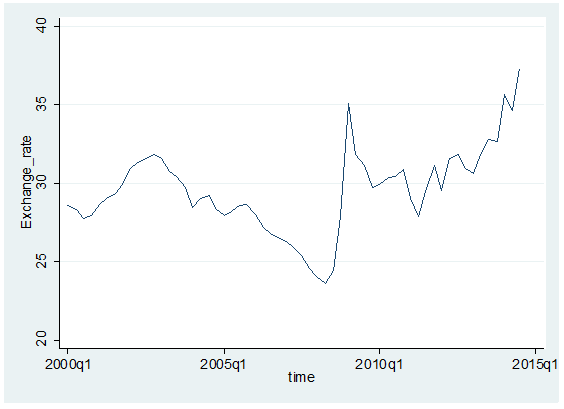
graphic of nominal exchange rate,
shown below, helps to demonstrate visually the existence and the magnitude of
exchange rate volatility from the first quarter of 2000 to the third quarter of
2014. this graph we can see that high volatility is near high volatility and
the low volatility is near low volatility. As a consequent, it is possible to
make following conclusion about clustering of volatility - visual information
provides us with the opportunity to use ARCH model for estimating nominal
exchange rate volatility RUB/USD.graph of other observed variables can be found
in Appendix B.
descriptive statistics of values of
economic parameters, used in the research, with the time span from the first
quarter of 2000 to the third quarter of 2014, are demonstrated below:
Table 2
It is possible to prove the
expectations about direction of impact of real effective exchange rate RUB/USD
and Russian industrial production on Russian export, described in empirical
methodology, by using correlation analysis:
Table 3
As it is seen from the preliminary
results, export and real effective exchange rate and export and industrial
production are positively linked.
3. Empirical
analysis
3.1 Stationarity of
variables
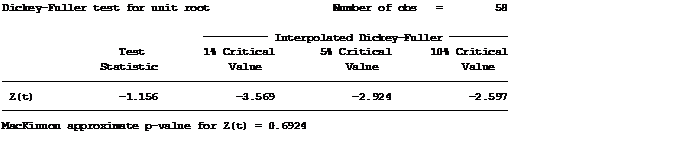
, it is really crucial to test time
series of logarithmic values of nominal exchange rate, real effective exchange
rate, industrial production and export for stationarity. Using non-stationary
time series may lead to “spurious regressions”.
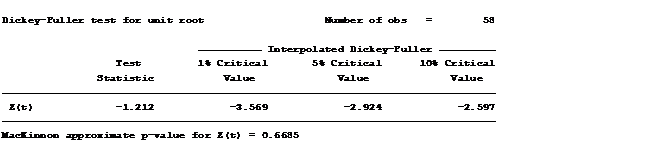
values of
export:
Logarithmic values of real effective
exchange rate:
Logarithmic values of industrial
production:
Logarithmic values of nominal
exchange rate:
As it is seen from the obtained
results, none of the variables is stationary time-series, because the null
hypothesis that the time series contains the unit root is accepted at the
significance level of 1 % (The real effective exchange rate is a stationary
time series at the significance level of 5 %). In order to overcome the problem
of non-stationary time series, it is high time to shift to the analysis of the
first difference of investigated variables.first difference of logarithmic
values of export:
The first difference of logarithmic
values of real effective exchange rate:
The first difference of logarithmic
values of industrial production:
All in all, according to results of
tests, the problem of non-stationary time series is resolved for export, real
effective exchange rate, industrial production, nominal exchange rate, because
the first differences of these variables are stationary time series at the
significance level of 1 % (The null hypothesis that these new obtained time
series contain the unit root is rejected at the significance level of 1 %).
.2 Estimating nominal exchange rate
volatility by using ARCH model
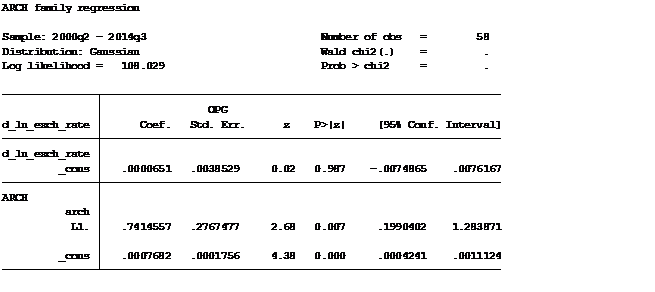
, ARCH model is constructed for
further estimation of nominal exchange rate volatility RUB/USD, it is essential
to test the existence of ARCH effects for the nominal exchange rate RUB/USD. In
order to achieve this aim, LM test is conducted.
The obtained results show that the
null hypothesis that there are no ARCH effects for the nominal exchange rate
RUB/USD is rejected at the significance level of 1 %. Consequently, ARCH
effects are observed for the nominal exchange rate RUB/USD. Now it is possible
to build ARCH model.
The coefficient before ARCH
parameter is significant at the significance level of 1 %, while it is also
positive. This intermediate result allows to explain continue estimation of
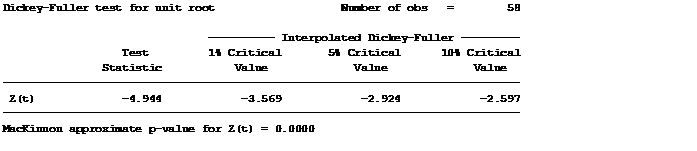
exchange rate volatility.’s test the obtained by using ARCH model time series
of estimates of nominal exchange rate volatility RUB/USD for stationarity:
The null hypothesis that this time
series contains the unit root is rejected at the significance levelof 1 %.
Respectively, the estimated exchange rate volatility is a stationary rime
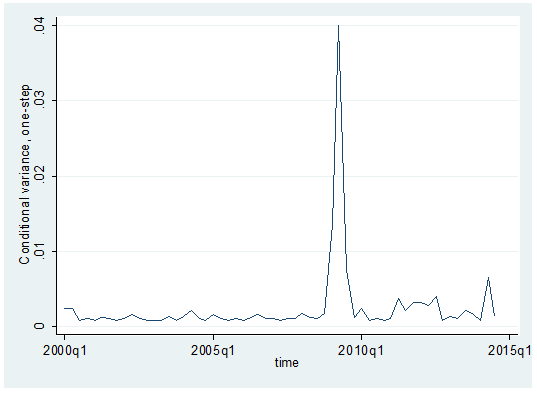
series and it is possible to continue empirical analysis.graphic of nominal
exchange rate volatility RUB/USD, obtained by using ARCH model, during the
period from the first quarter of 2000 to the third quarter of 2014, looks:
3.3 Constructing ADL
regressions
of all, it is essential to build
regression, which incorporates following independent variables: the first lags
of export, industrial production, real effective exchange rate and volatility,
as well as the current values of industrial production and real effective
exchange rate (In the model only the first lags are used, because the optimal
structure of the lags involves only the first lags, according to information
criteria (Appendix A)). As a result, we obtain the following model:
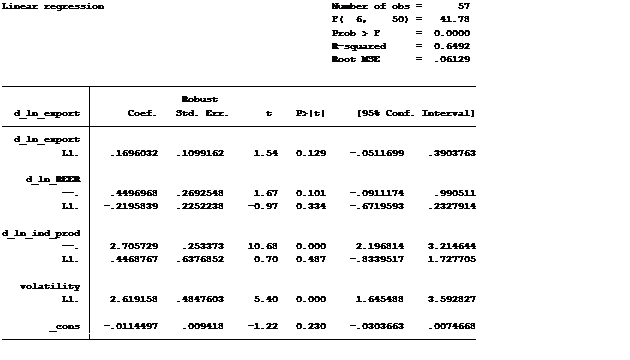
From this table it can be inferred
that the coefficient before the current values of industrial production, as
well as the coefficient before the first lag volatility are significant,
because the null hypothesis that coefficients before these variables equal to
null. On the other hand, other coefficients are insignificant. Now it would be
an excellent idea to construct regression, incorporating the first lags of
export and volatility and the current values of real effective exchange rate and
industrial production
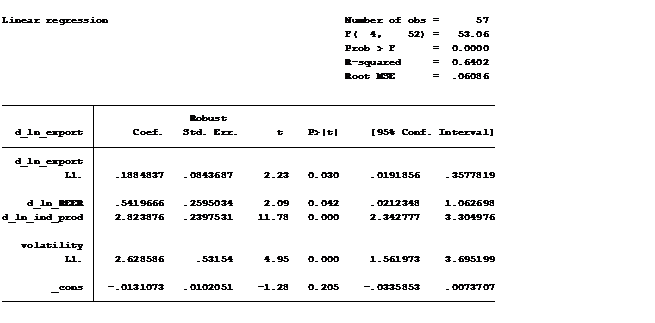
In the obtained model all
coefficients are significant. The impact of industrial production and real
effective exchange rate turns to be positive, as it has been expected. The
growth of industrial production leads to increase in export, while the rise of
real effective exchange rate causes the increase in export. The value of export
in the previous period (the first lag of export) positively affects the current
value of export, which seems rather evident. The positive sign of the
coefficient before the first lag of nominal exchange rate volatility means that
the obtained result is not intuitive: if the nominal exchange rate volatility
RUB/USD goes up, the growth of export will happen.
.4 Determination of causality
between export and volatility
spite of the fact that the positive
impact of exchange rate volatility in the previous period on current value of
export is obtained, this finding does not withdraw the question causality
between exchange rate volatility and export: not only exchange rate volatility
causes changes in export, but also export causes changes in exchange rate
volatility. In order to find an answer to this question it is essential to
method, described above: construction of two regressions with export and
exchange rate volatility as dependent variables and the first lags of exchange
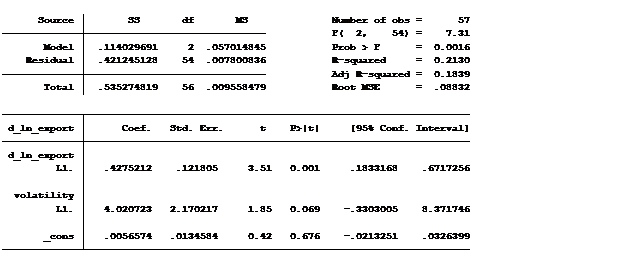
rate volatility and export as independent variables.first regression with
export as a dependent variable:
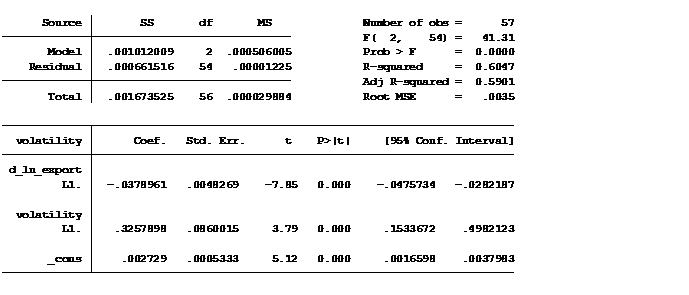
The second regression with exchange
rate volatility as a dependent variable:
Taking into account the second
regression with the exchange rate volatility as a dependent variable, it is
remarkable that he first lag of values of export have a negative impact on
current exchange rate volatility. This interesting result can be explained so:
more closed economies required larger changes in exchange rates in order to
achieve the adjustments of balance of payments (The ratio export and GDP
(export/GDP) can be considered as a measure of openness of the economy)
(Canales-Kriljenko & Habermeier, 2004). What is more, other explanations
are also possible.these two regressions it can be concluded that not only the
exchange rate volatility in the previous period has an impact on export in the
current period, but also the export in previous period has an influence on
exchange rate volatility in the current period. Therefore, it is impossible to
make an inference about the unambiguous direction of the effect of exchange
rate volatility on export, because the both influence of the first lag of
exchange rate volatility on current export and impact of the first lag of
export on current exchange rate volatility.
4. Future research
the fact that the result is
obtained, it is essential to note what might be done in this area in the
future. First of all, it would be a good idea to investigate disaggregated data
of various branches of the national economy of Russian Federation (agriculture,
food industry, light industry etc). In this case the influence of each
variable, investigated in this research, for every sector. It is rather
plausible that the influence of exchange rate volatility is different for
different branches or is significant for some sectors and insignificant for
others.is more, the obtained model can be improved by adding the determinants
of export that are not used in this work. For instance, investigating the role
of variables, related to government influence on export: subsidies to
companies, exporting goods.into consideration that Russian government shifted
from fixed to floating exchange rate system at the end of 2014, it would be
interesting to conduct analogical research, but using future data in order to
answer the question: does the influence of exchange rate volatility change, in
the light of the larger exchange rate fluctuations.
Conclusion
work represents an empirical
research of the impact of nominal exchange rate volatility RUB/USD on export of
Russian export by using the time series of real effective exchange rate RUB/USD,
nominal exchange rate RUB/USD, expot of Russian Federation and Russian
industrial production during approximately fourteen years: from the first
quarter of 2000 to the third quarter of 2014. In order to estimate nominal
exchange rate volatility, ARCH model is applied. The obtained autoregressive
model with distributed lags tells us that the value of estimated nominal
exchange rate volatility in the previous period positively influence the export
in the current period, as well as other variables: current values of real
effective rate and industrial production and the first lag of export have an
expected positive effect on current export. On the other hand, it is defined
that the first lag of export affects the current exchange rate volatility.
Consequently, the mutual influence of export and exchange rate volatility is
observed. This fact can explain, in addition to other interpretations, the
positive impact of the nominal exchange rate volatility RUB/USD on export of
Russian Federation. Nevertheless, it would be a good idea for our Central Bank
not to spend great efforts on stabilization of the exchange rate RUB/USD, but
concentrate on stimulating economic growth in our country by reducing interest
rates in order to increase private investments. However, it is clear that it is
essential to conduct further research in order to find the most effective
policy of Central Bank for achieving maximal economic result for Russian
Federation.
References
1. Broll U., & Eckwert B.
(1999). Exchange rate volatility and international trade. Southern Economic
Journal, 178-185.
2. Broll U., Wahl J.E.,
& Wong W.K. (2006). Elasticity of risk aversion and international trade.
Economics Letters,92(1), 126-130.
. Canales-Kriljenko
J.I., & Habermeier K. (2004). Structural factors affecting exchange rate
volatility: A cross-section study.
. Clark P., Tamirisa N.,
Wei S.J., Sadikov A., & Zeng L. (2004). Exchange rate volatility and trade
flows-some new evidence. IMF Occasional Paper,235.
5. Côté A.
(1994). Exchange rate volatility and
trade.Bank of Canada Work. Pap, 94-5.
. De Grauwe P. (1988).
Exchange rate variability and the slowdown in growth of international
trade.Staff Papers-International Monetary Fund, 63-84.
. Engle R.F. (1982).
Autoregressive conditional heteroscedasticity with estimates of the variance of
United Kingdom inflation. Econometrica: Journal of the Econometric Society,
987-1007.
. Franke G. (1991).
Exchange rate volatility and international trading strategy.Journal of
International Money and Finance,10(2), 292-307.
. Hill R.C., Griffiths
W.E., & Lim G.C. (2008).Principles of econometrics (Vol. 5). Hoboken, NJ:
Wiley.
. Hooper P., &
Kohlhagen S.W. (1978). The effect of exchange rate uncertainty on the prices
and volume of international trade. Journal of International Economics,
8(4), 483-511.
. Ozturk I. (2006).
Exchange rate volatility and trade: a literature survey. International Journal
of Applied Econometrics and Quantitative Studies, 3(1).
. Sercu P., & Uppal
R. (2003). Exchange rate volatility and international trade: A
general-equilibrium analysis. European Economic Review,47(3), 429-441.
. Thurman W.N., &
Fisher M.E. (1988). Chickens, eggs, and causality, or which came first.
American Journal of Agricultural Economics,70(2), 237-238.
. Viaene J.M., & De
Vries C.G. (1992). International trade and exchange rate volatility.European
Economic Review, 36(6), 1311-1321.
. Wang K.L., &
Barrett C.B. (2007). Estimating the effects of exchange rate volatility on
export volumes. Journal of Agricultural and Resource Economics, 225-255.
. Wei S.J. (1999).
Currency hedging and goods trade. European Economic Review, 43(7), 1371-1394.
. Economic Data Federal
Reserve Bank of St. Louis
rate volatility
autoregressive export
Appendix A
criteria for the model,
incorporating only the first lags
Information criteria for the model,
incorporating the first two lags
Information criteria for the model,
incorporating the first three lags
Appendix B
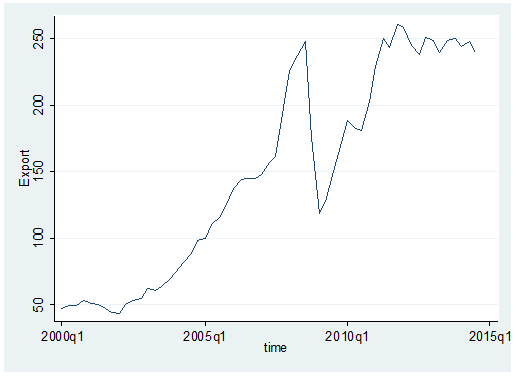
of export during the observed period
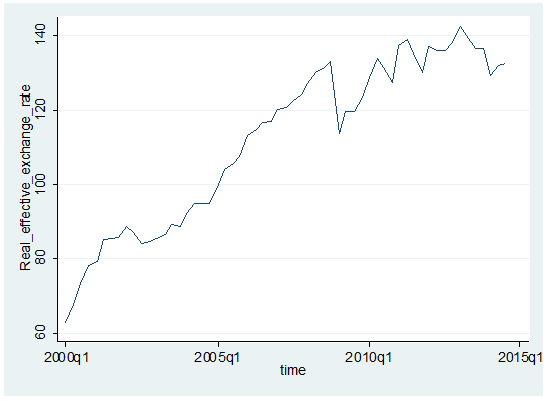
of real effective exchange rate
RUB/USD during the observed period
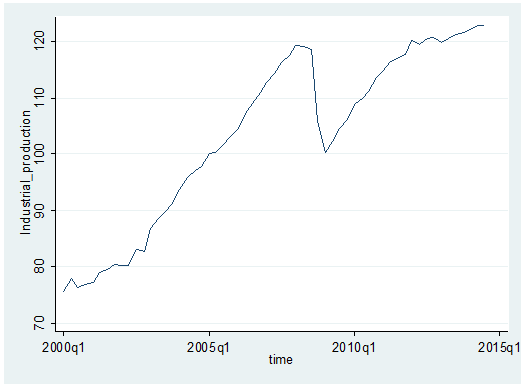
Graph of industrial production
RUB/USD during the observed period
 >0, 0<
  <1
<1
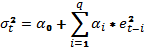
 depends on the squares of the
errors in the previous periods (
depends on the squares of the
errors in the previous periods ( ). It is crucial to mention that all
coefficients before ARCH parameter in this model must be positive and not be
more than one (0< <1) Moreover, the constant term
must be also positive. ARCH model was proposed by R.F. Engle in his article
“Autoregressive conditional heteroskedasticity with estimates of the variance
of United Kingdom inflation” (1982). Nowadays ARCH model is widely used for
various purposes of investigations of different financial time series,
including the estimating exchange rate volatility. The main attractive feature
of this model is that it does not neglect “news”. What is more, ARCH model pays
to attention to the clustering of volatility, when high volatility follows high
volatility and low volatility follows low volatility, which is rather common
for real economies.
). It is crucial to mention that all
coefficients before ARCH parameter in this model must be positive and not be
more than one (0< <1) Moreover, the constant term
must be also positive. ARCH model was proposed by R.F. Engle in his article
“Autoregressive conditional heteroskedasticity with estimates of the variance
of United Kingdom inflation” (1982). Nowadays ARCH model is widely used for
various purposes of investigations of different financial time series,
including the estimating exchange rate volatility. The main attractive feature
of this model is that it does not neglect “news”. What is more, ARCH model pays
to attention to the clustering of volatility, when high volatility follows high
volatility and low volatility follows low volatility, which is rather common
for real economies.


 - the value of Russian export at
the period t
- the value of Russian export at
the period t
 - the value of Russian industrial
production at the period t
- the value of Russian industrial
production at the period t
 - the value of real effective
exchange rate RUB/USD at the period t
- the value of real effective
exchange rate RUB/USD at the period t
 - nominal exchange rate volatility
RUB/USD at the period t-1 optimal structure should be defined by using
information criteria.
- nominal exchange rate volatility
RUB/USD at the period t-1 optimal structure should be defined by using
information criteria.
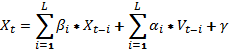
 is accepted, it is possible to say
that the nominal exchange rate volatility does not cause changes in export. ,
we define the causality from export to exchange rate volatility.
is accepted, it is possible to say
that the nominal exchange rate volatility does not cause changes in export. ,
we define the causality from export to exchange rate volatility.
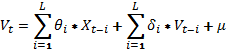
 is accepted, it is possible to say
that the export does not cause changes in exchange rate volatility.
is accepted, it is possible to say
that the export does not cause changes in exchange rate volatility.
 1
1













 2
2