Материал: 2358

emergency. The first was to press on the brake and gear-change pedals simultaneously, thus also engaging first gear. For even fiercer braking one pressed simultaneously the brake pedal and a third pedal, which engaged reverse gear.
The second big American motor company, General Motors – for long
Сthe largest and most powerful commercial organization in the world was
111
founded in 1908, the result of the patient, tenacious work of another outstanding individual, William Crapo Durant. He, like Ford, had begun in the early years of the 20th century but the aims and methods of the two men wereиquite different. Ford was in essence a technician, with clear, precise commercial ideal stemming from a real passion for the motor car. Durant was a business man who, like other of the time, had seen the future possibilities of the car and who had decided to reach the highest levels of the boom whoseбАadvent he foresaw so clearly.
Текст 2
GENERAL MOTORS CORPORATION
In the early 1900’s Billy Durant, grandson of a Governor of Michigan, was already a millionaire, having founded a successful handcart factory with his partner, Josiah Dallas Dart, an ex-dealer in trinkets. These two decided to convert their factory in Flint to motor car production, Durant being particularly keen to do so. TheirДproblem was to find a farely wellknown make, preferably in financial difficulties, which their assistance could turn into a financial success. Buick fitted the bill.
David Dunbar Buick was in an ex-tinsmith, also from Michigan, who, having amassed a substantial fortune from his patents on the application of enamel to cast-iron, decided to build motorИcars. His prototype for a light car created interest; it had a well-balanced engine, a pleasing appearance, and certain good technical details, notably pushrod-operated overhead valves. The financial aspects of the company, however, were not equally good. The Buick Manufacturing Company, in fact, became the Buick Motor Car Company after only one year, when it accepted a contribution of new capital from the Briscoe brothers. The association with the Briscoes did not last long. When they saw the way the company's finances were going they withdrew, and Buick, in spite of his ingenious ideas and the success of the few vehicles built, found himself on the brink of bankruptcy. It was in this way that Durant, in November 1904, was able to get his hands on the Buick business. He immediately increased the company's
111

capital from $75.000 to $300,000, and later to $500,000. He transferred the works to Flint, not to his own factory but to that of the Flint Wagon Works, another company with which he had recently become associated.
The impulse that Durant gave to the Buick business is shown by the production figures; they passed from 28 machines, in 1904, through 626 in
С1905, to 2,300 in 1906. By 1908 Buick production was sufficient for Du-
112
rant to consider his next step towards the motor industry throne that was clearly his ambition. Instead of buying another motor company, he set up a much higher goal – nothing less than a trust to incorporate all, or at least mostиof the big American motor manufacturers, a trust with the then fantastic production of 50,000 units per year.
Durant did not waste any time. He went so far as to found the new company first, with the grandiose title of International Motor Company, and then sentбАhis emissaries to talk to the major competitors. Ford, obviously the prime objective of this larger scale operation, gave a decisive “no”. Reo and Maxwell-Briscoe also refused. Never one to lose time up blind alleys, Durant changed his tactics at once and on 16th September 1908, founded a second company – General Motors with an initial capital of $12,500,000. This company was given the task of acquiring motor companies which found themselves in difficulty, including those manufacturing accessories.
The first companies absorbed by General Motors had already been previously incorporated by the InternationalДMotor Co. They were Dow, Ewing Automobile, Carter Car Company, and Elmore, all of minor importance and forgotten today. To these were added the Western Mott, manufacturers of axles, and Champion, of enduring sparking plug fame.
Following his plan of absorbing all the accessory-producing companies, Durant next bought the Briscoe Company (whichИhad initially refused to join G.M.) and later made his first major acquisition – Oldsmobile – major more for its reputation than for its production record.
All these acquisitions had been made in a few months – five, to be precise – and Durant, motivated not so much by success as by the need at that stage to impress his associates, paid $245,000 in dividends to the shareholders. By now Durant had the bit between his teeth, and on 28th July, 1909 he bought Cadillac for $3,400,000.
A little later Durant conceived the most ambitious plan of his career
– nothing less than the acquisition of Ford, for which ‘fabulous Billy’, as he had been christened by Wall Street, was prepared to pay the unprecedented sum of $8,000,000.
112

With Ford’s refusal, Durant’s star began to decline. It was typical of American high finance in those years that the absolute faith that had made almost unlimited funds available to him was quickly changed into suspicion – of his ambition and of the scale of his plans – and then into open alarm. Wall Street turned its back on him, he was asked to resign, and was
Сsubstituted by Charles W. Nash. Nash had been a collaborator of Durant in
113
the letter’s Flint factory. He was made president of Buick after its purchase by Durant, and had led that company to unheard-of prosperity. It is not
surprising that the shareholders saw in him someone who was capable of taking over – with a less ambitious and more realistic policy – from 'fabulous Billy'.
и eral Motors,бАthanks to his success with a new name -Chevrolet. He was fi-
We might add that this was by no means the end of Durant. Five years later, (in 1915) he was once more triumphantly at the head of Gen-
nally to leave the company in 1920 when another crisis made G.M. shares fall from $400 a share to $12. Even after this he was to figure largely in the activities of other new makes — Durant, Dort, Star and Mason — until the crisis of 1929 finally pushed him into obscurity. He died a largely forgotten man in 1947.
Текст 3 FERRARI 250GTO
The seven letters of the name ‘Ferrari’ (fig. 13) produce a quickening of the pulse for any car enthusiast. If you’re a dedicated Ferrari fan however, just the three letters GTO are all it takes to get the adrenaline pumping.
To the devoted, everything else is just a little ordinary by comparison; even |
|
the F40s, Berlinetta Boxers and 275GTBs. The GTO is THE Ferrari – and |
|
|
И |
perhaps THE car of all time. Why is the GTO so special? There are several |
|
compelling reasons. |
Д |
113
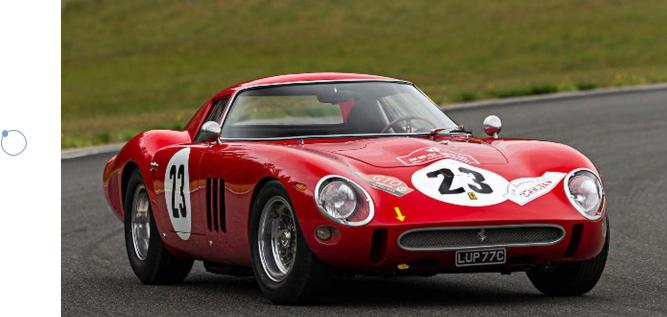
С114
и бАFig. 13. Ferrari 250GTO
Firstly, the GTO helped Ferrari win three World Championships in a row from 1962 to 1964. Yet it was a real rarity, a racer that could be driven on the road. On top of that, only 39 were ever made. That makes the 250GTO ultra-desirable whichever way you care to look at it.
To understand the GTO, car enthusiasts have to realise why it was conceived. Racing during the 1950s had become very much faster and consequently more dangerous. The deathДof 82 people at Le Mans in 1955 was the catalyst which split top-flight racing into categories. One of these was the new grand tourer class, which required that cars should have closed coupe bodies which resembled to a large degree those of the manufacturer's road cars. A minimum of a hundred examples of each of these race
cars had to be built. И By the beginning of the 1960s, Enzo Ferrari’s were dominant in rac-
ing, so he took the new class very seriously. He certainly faced some stiff competition from the Aston Martin DB4 Zagato and the new Jaguar E- Type. Ferrari’s competitor was the 250GT, the first volume-produced Ferrari. It used the same basic chassis as that of the 166, first seen in 1947, which provided excellent handling. However, the 250GT was not strong on all-out speed.
Enzo thought that he could beat the opposition with a more powerful engine but Chief engineer Carlo Chiti argued that the car's blunt aerodynamics were at fault. He went to great pains to have a wind tunnel installed at Ferrari's HQ in Modena. The result was that the engine remained much
114

the same as before: a glorious 3.0-litre V12 unit designed by Gioacchino Colombo. The size of each individual cylinder was 250cc, hence the '250' name. In specification, it mirrored the Testa Rossa pure racing car, including dry sump lubrication and six twin-choke Weber carburettors.
Ferrari developed a new five-speed, all-synchromesh gearbox but the
Сchassis remained much as before but with a short wheelbase. The reason-
115
ing was the Ferrari faces enough problems getting the car through the 100car homologation rule without having to argue about the chassis as well.
Standard 250GT suspension used coil springs at the front and the rigid axle with leaf springs at the back. Development engineer Giotto Bizzarrini wanted to up-rate the rear to coil springs as well but Enzo did not agree.
и virtually handбА-built, mostly for very wealthy private individuals who fan-
The new car arrived in February 1962 and was christened 250GTO, the magical letters standing for Gran Turismo Omologato. Each car was
cied their chances at a racing career. All GTOs were given odd chassis numbers (at a time when racing cars were traditionally allocated even numbers), which has given rise to some confusion over the exact number of GTOs built. However, most historians now agree on 39, a figure which fell way below the supposed Minimum’ of 100. Each one was slightly different and some, like Bizzarrini’s triplet of restyled ‘bread van’ GTOs were very different.
The styling was gorgeous, the work of Ferrari’s own engineers. It
Series II to incorporate a notchback.Д
made use of the Kamm tail principle, which yielded enhanced aerodynamics for cars with sloping tails. Overall, the GTO was 6.6in longer and 3.5in lower than the short wheelbase 250GT Berlinetta. Construction was very
lightweight, with all-aluminium bodies created in the tiny Modena work-
shop of Sergio Scaglietti. The body styling would later change on the 1964 И
As a race car, the 250GTO was highly successful. From its first outings it proved its superiority over the opposition in endurance events and the World Championship. Phil Hill came second in the 1962 Sebring, the GTO's debut event. In the hands of drivers like Mike Parkes and the late,
great Rodriguez brothers, it made Ferrari dominant on the track. In Class III of the 1962 championship, Ferrari GTOs won a crushing victory with maximum points – despite the Italian giant not having an official works team.
Its only competition came from the lightweight Jaguar E-Type (from 1963) and the AC Cobra (from 1964).
A single 4.0-litre GTO was developed and raced by Parkes and
115